
As a former linguistics professor who now spends her time analyzing daily search data, I find immense joy in examining each week's Wordle words and their corresponding Google Trends obscurity spikes. There is a fascinating human behavior captured in these charts: after struggling through a tough word game challenge, players who scrambled through their final guesses routinely head straight to Google to discover what the target word actually means. That post-game play curiosity turns a simple daily word challenge into a delightful micro-lesson in English lexicography.
When studying these trends, it is worth remembering that our metric focuses on relative percentage growth rather than raw query volume alone. A word sitting at a dormant baseline requires only a modest absolute rise to produce a massive relative spike, whereas terms with higher steady background searches demand immense volume to shift their percentage significantly. Before we dive into the data, it is also charming to notice how certain five-letter targets double as subtle anagram puzzles; for instance, PENAL can easily be jumbled into everyday terms like PANEL or PLANE, while POSIT neatly rearranges into TOPIS.
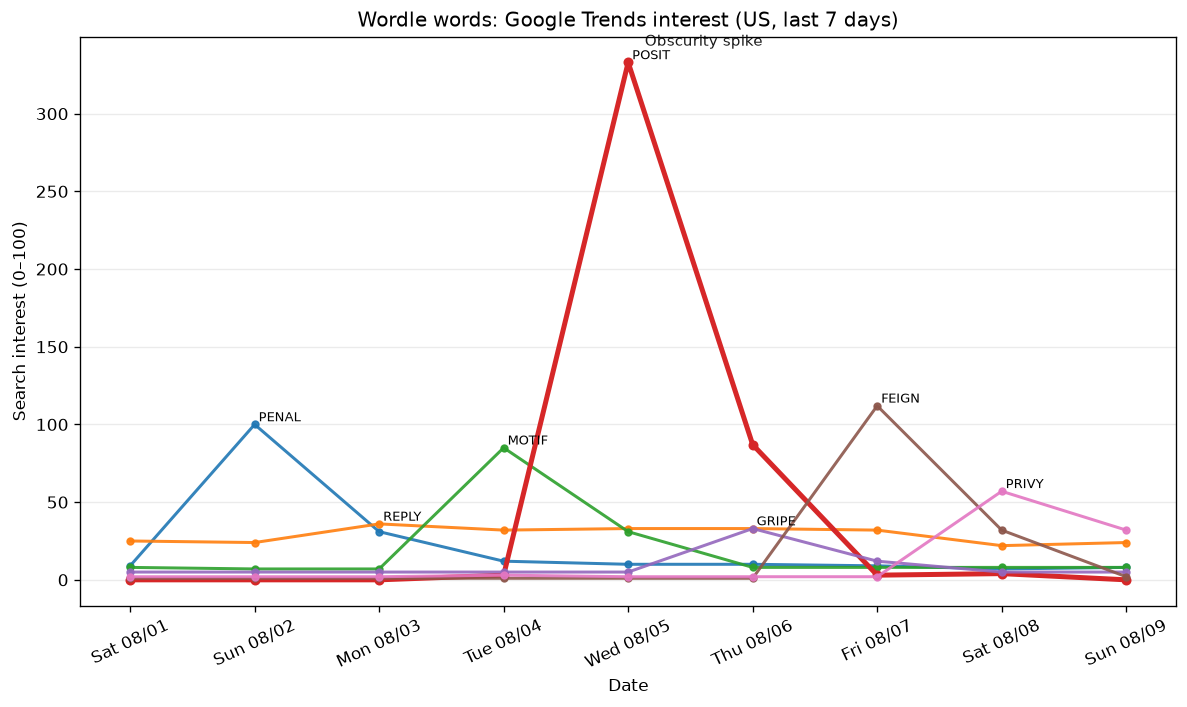
About this chart. Each line is one Wordle answer’s search interest in the United States over the past seven days (Google Trends “Interest over time”). Values are on Google’s 0–100 scale, so you can compare how often people searched each word relative to the others this week.
How the Spike % is calculated. For each word we take the quietest day in that window (the lowest point on its line) as its usual level for the week, and the busiest day (the highest point) as the peak. The spike is the percentage increase from that low to that high: (peak − low) ÷ max(low, 1) × 100. If the week’s low is zero, we divide by 1 instead of 0 so the spike still measures how much interest rose from the floor to the peak. A larger spike means searches jumped more sharply when that word was the daily answer.
This week’s words
| Date | Word | Spike | Meaning |
|---|---|---|---|
| Sun, Aug 2 | PENAL | +1329% | (adj.) Of or relating to punishment or penalties. |
| REPLY | +64% | (v.) To answer or respond to something said or written. (n. pl. replies) An answer or response. | |
| Tue, Aug 4 | MOTIF | +1114% | (n. pl. motifs) A recurring idea, theme, or image in a work of art, literature, or music. (n. pl. motifs) A distinctive and often repeated design or pattern, especially in decoration or fabric. |
| Wed, Aug 5 | POSIT | +33300% | (v.) To place or set in a particular position. (v.) To propose or assume as a fact or principle. |
| Thu, Aug 6 | GRIPE | +560% | (v.) To complain in a nagging or persistent way. (n. pl. gripes) A minor complaint. |
| Fri, Aug 7 | FEIGN | +11100% | (v.) To pretend. (v.) To give a false appearance of; to simulate. |
| Sat, Aug 8 | PRIVY | +2750% | (adj. privier, priviest) Sharing in the knowledge of something secret or private. (n. pl. privies) An outhouse; a toilet located outside a building. |
Obscurity winner
Analyzing search interest in the United States over the past seven days highlights POSIT as our undisputed obscurity leader. Registering a baseline near absolute zero before climbing dramatically to a relative peak index of 333, it recorded an extraordinary spike of approximately 33300%. While POSIT carries a moderate game difficulty score of 66, its standard usage in everyday conversation is rare enough that solvers scrambled to verify its precise academic sense once their grid was solved.
Our runner-up for the week was FEIGN, which generated a commendable 11100% search surge (moving from a baseline low near 1 to a peak of 112). Words like FEIGN and PRIVY (+2750%) demonstrate how silent letters or archaic roots trigger immediate lookup spikes among word game players looking to expand their working vocabulary.
View these words on Google Trends (US, last 7 days)
The top 5 most obscure words used in Wordle since March 1, 2026, remain unchanged on our historical leaderboard: SHILL (+150000%), LORRY (+145000%), OVATE (+110000%), PIZZA (+103300%), and STEAK (+83300%).
Word game sentence
Although the privy counselor feigned ignorance during the meeting, he promptly replied to the committee's gripes by positing a new policy to penalize recurring safety violations that contradicted the project's central aesthetic motif.
From a stylistic standpoint, this sentence manages to integrate all seven word roots without succumbing to excessive syntactic awkwardness. Integrating legal jargon like penalize alongside philosophical terms like positing reflects how cleanly varied academic registers can coexist within a single coherent thought. It is always a pleasure to see how a simple daily word puzzle continue to enrich our shared appreciation for the versatility of the English language.
For Math Nerds
What this section is for. It documents exactly how each week’s spike numbers were computed from the scaled Google Trends series, so curious readers can verify the arithmetic.
Trends window. We request a custom date range 2026-08-01 2026-08-09 (US), which is the Wordle week plus one day before and after so the chart has a little context on each side. The anchor keyword for cross-request scaling is PENAL (the first day’s answer, in chronological order).
Scaling across separate requests. Google Trends only returns relative 0–100 values within one request. We fetch each answer in its own request paired with that anchor, then rescale each day so the anchor’s curve matches the anchor series from the first request. Concretely: scaledword(d) = rawword(d) × base_anchor(d) / rawanchor(d) when rawanchor(d) > 0, else 0.
Spike % for one word. Let L be the minimum and H the maximum of that word’s scaled daily values over the window (see table below). Define spike% = (H − L) / max(L, 1) × 100 when L ≠ H, otherwise 0%. Using max(L, 1) avoids division by zero when L = 0.
PENAL (Wordle day 2026-08-02)
Scaled interest by date; spike for rankings uses +1329% from this series.
| Date | Interest |
|---|---|
| 2026-08-01 | 9 |
| 2026-08-02 | 100 |
| 2026-08-03 | 31 |
| 2026-08-04 | 12 |
| 2026-08-05 | 10 |
| 2026-08-06 | 10 |
| 2026-08-07 | 9 |
| 2026-08-08 | 7 |
| 2026-08-09 | 8 |
- L = 7 on: 2026-08-08
- H = 100 on: 2026-08-02
- Denominator
max(L, 1)= 7 - (100 - 7) / 7 * 100 = 1328.5714%
REPLY (Wordle day 2026-08-03)
Scaled interest by date; spike for rankings uses +64% from this series.
| Date | Interest |
|---|---|
| 2026-08-01 | 25 |
| 2026-08-02 | 24 |
| 2026-08-03 | 36 |
| 2026-08-04 | 32 |
| 2026-08-05 | 33 |
| 2026-08-06 | 33 |
| 2026-08-07 | 32 |
| 2026-08-08 | 22 |
| 2026-08-09 | 24 |
- L = 22 on: 2026-08-08
- H = 36 on: 2026-08-03
- Denominator
max(L, 1)= 22 - (36 - 22) / 22 * 100 = 63.6364%
MOTIF (Wordle day 2026-08-04)
Scaled interest by date; spike for rankings uses +1114% from this series.
| Date | Interest |
|---|---|
| 2026-08-01 | 8 |
| 2026-08-02 | 7 |
| 2026-08-03 | 7 |
| 2026-08-04 | 85 |
| 2026-08-05 | 31 |
| 2026-08-06 | 8 |
| 2026-08-07 | 8 |
| 2026-08-08 | 8 |
| 2026-08-09 | 8 |
- L = 7 on: 2026-08-02, 2026-08-03
- H = 85 on: 2026-08-04
- Denominator
max(L, 1)= 7 - (85 - 7) / 7 * 100 = 1114.2857%
POSIT (Wordle day 2026-08-05)
Scaled interest by date; spike for rankings uses +33300% from this series.
| Date | Interest |
|---|---|
| 2026-08-01 | 0 |
| 2026-08-02 | 0 |
| 2026-08-03 | 0 |
| 2026-08-04 | 3 |
| 2026-08-05 | 333 |
| 2026-08-06 | 87 |
| 2026-08-07 | 3 |
| 2026-08-08 | 4 |
| 2026-08-09 | 0 |
- L = 0 on: 2026-08-01, 2026-08-02, 2026-08-03, 2026-08-09
- H = 333 on: 2026-08-05
- Denominator
max(L, 1)= 1 - (333 - 0) / 1 * 100 = 33300.0000%
GRIPE (Wordle day 2026-08-06)
Scaled interest by date; spike for rankings uses +560% from this series.
| Date | Interest |
|---|---|
| 2026-08-01 | 5 |
| 2026-08-02 | 5 |
| 2026-08-03 | 5 |
| 2026-08-04 | 5 |
| 2026-08-05 | 5 |
| 2026-08-06 | 33 |
| 2026-08-07 | 12 |
| 2026-08-08 | 5 |
| 2026-08-09 | 5 |
- L = 5 on: 2026-08-01, 2026-08-02, 2026-08-03, 2026-08-04, 2026-08-05, 2026-08-08, 2026-08-09
- H = 33 on: 2026-08-06
- Denominator
max(L, 1)= 5 - (33 - 5) / 5 * 100 = 560.0000%
FEIGN (Wordle day 2026-08-07)
Scaled interest by date; spike for rankings uses +11100% from this series.
| Date | Interest |
|---|---|
| 2026-08-01 | 1 |
| 2026-08-02 | 1 |
| 2026-08-03 | 1 |
| 2026-08-04 | 1 |
| 2026-08-05 | 1 |
| 2026-08-06 | 1 |
| 2026-08-07 | 112 |
| 2026-08-08 | 32 |
| 2026-08-09 | 2 |
- L = 1 on: 2026-08-01, 2026-08-02, 2026-08-03, 2026-08-04, 2026-08-05, 2026-08-06
- H = 112 on: 2026-08-07
- Denominator
max(L, 1)= 1 - (112 - 1) / 1 * 100 = 11100.0000%
PRIVY (Wordle day 2026-08-08)
Scaled interest by date; spike for rankings uses +2750% from this series.
| Date | Interest |
|---|---|
| 2026-08-01 | 2 |
| 2026-08-02 | 2 |
| 2026-08-03 | 2 |
| 2026-08-04 | 3 |
| 2026-08-05 | 2 |
| 2026-08-06 | 2 |
| 2026-08-07 | 2 |
| 2026-08-08 | 57 |
| 2026-08-09 | 32 |
- L = 2 on: 2026-08-01, 2026-08-02, 2026-08-03, 2026-08-05, 2026-08-06, 2026-08-07
- H = 57 on: 2026-08-08
- Denominator
max(L, 1)= 2 - (57 - 2) / 2 * 100 = 2750.0000%
Ranking order sorts words by spike% descending; ties are broken only by Python’s stable sort (original dict iteration order), not by puzzle date.