
Welcome back to our weekly analytical recap. I have been reviewing last week's Wordle words and their Google Trends obscurity spikes, as I always enjoy observing how solvers, right after wrestling with a particularly tricky daily challenge, head straight over to search Google to uncover what a word actually means. It is fascinating to watch how our morning play can instantly transform an everyday letter scramble into a nationwide vocabulary lesson.
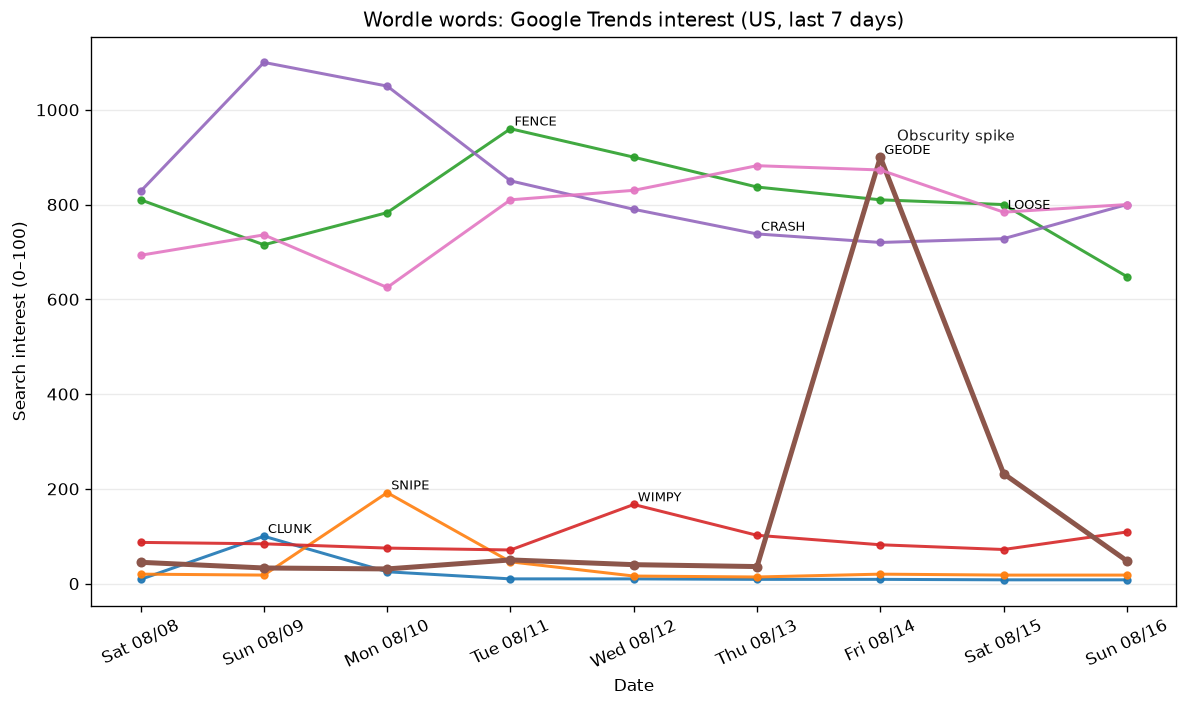
About this chart. Each line is one Wordle answer’s search interest in the United States over the past seven days (Google Trends “Interest over time”). Values are on Google’s 0–100 scale, so you can compare how often people searched each word relative to the others this week.
How the Spike % is calculated. For each word we take the quietest day in that window (the lowest point on its line) as its usual level for the week, and the busiest day (the highest point) as the peak. The spike is the percentage increase from that low to that high: (peak − low) ÷ max(low, 1) × 100. If the week’s low is zero, we divide by 1 instead of 0 so the spike still measures how much interest rose from the floor to the peak. A larger spike means searches jumped more sharply when that word was the daily answer.
This week’s words
| Date | Word | Spike | Meaning |
|---|---|---|---|
| Sun, Aug 9 | CLUNK | +1150% | (v.) To make a dull, heavy sound. (n. pl. clunks) A dull, heavy sound. |
| Mon, Aug 10 | SNIPE | +1271% | (v.) To shoot at someone from a hidden position. (n. pl. snipes) A long-billed wading bird, often found in marshes. (v.) To make a sly or critical remark. |
| Tue, Aug 11 | FENCE | +48% | (n. pl. fences) A barrier, typically made of posts and wire or wood, used to enclose an area or mark a boundary. (v.) To enclose or separate with a fence. (v.) To engage in the sport of fencing; to fi |
| Wed, Aug 12 | WIMPY | +135% | (adj. wimpier, wimpiest) Lacking strength or courage; feeble or timid. |
| Thu, Aug 13 | CRASH | +53% | (v.) To hit something hard and noisily; to collide. (n. pl. crashes) A sudden loud noise, often from something breaking or falling. (v.) To fail suddenly or stop working. |
| Fri, Aug 14 | GEODE | +2803% | (n. pl. GEODES) A hollow, rounded rock with a cavity lined with crystals or other mineral matter. |
| Sat, Aug 15 | LOOSE | +41% | (adj. looser, loosest) Not firm, taut, or rigid; not tightly fastened. (v.) To set free; to release. (n.) The state of being loose; a release from restraint. |
Obscurity winner
Our clear standout this week is GEODE, which generated a massive obscurity spike of roughly 2803%. The geological term typically registers a quiet baseline of around 31 on our index, but it soared to 900 when it appeared as the daily solution. Mineralogists may find the term commonplace, but for the broader public, this crystal-lined rock proved to be a genuine linguistic roadblock.
Our runner-up for the week was SNIPE, which climbed 1271% from a baseline of 14 up to a peak of 192. Beyond its search spike, SNIPE is also an anagram lover's delight—a quick jumble of its letters yields familiar alternatives like SPINE and PINES, showcasing how easily a single grid entry can branch into its own mini-puzzle.
View these words on Google Trends (US, last 7 days)
The top 5 most obscure words used in Wordle, since I started tracking on March 1, 2026, remain SHILL (+150000%), LORRY (+145000%), OVATE (+110000%), PIZZA (+103300%), and STEAK (+83300%).
Word game sentence
When the wimpy hiker heard a loose geode clunk against the fence, he prepared for a sudden crash while his companion continued sniping about his clumsy trail technique.
Syntactically, blending informal descriptors like wimpy with geological and acoustic terms produces a slightly dramatic scene, though the narrative flow holds together remarkably well. Navigating these unexpected vocabulary intersections is part of what makes engaging with a clever word game such an enjoyable daily ritual.
For Math Nerds
What this section is for. It documents exactly how each week’s spike numbers were computed from the scaled Google Trends series, so curious readers can verify the arithmetic.
Trends window. We request a custom date range 2026-08-08 2026-08-16 (US), which is the Wordle week plus one day before and after so the chart has a little context on each side. The anchor keyword for cross-request scaling is CLUNK (the first day’s answer, in chronological order).
Scaling across separate requests. Google Trends only returns relative 0–100 values within one request. We fetch each answer in its own request paired with that anchor, then rescale each day so the anchor’s curve matches the anchor series from the first request. Concretely: scaledword(d) = rawword(d) × base_anchor(d) / rawanchor(d) when rawanchor(d) > 0, else 0.
Spike % for one word. Let L be the minimum and H the maximum of that word’s scaled daily values over the window (see table below). Define spike% = (H − L) / max(L, 1) × 100 when L ≠ H, otherwise 0%. Using max(L, 1) avoids division by zero when L = 0.
CLUNK (Wordle day 2026-08-09)
Scaled interest by date; spike for rankings uses +1150% from this series.
| Date | Interest |
|---|---|
| 2026-08-08 | 9 |
| 2026-08-09 | 100 |
| 2026-08-10 | 25 |
| 2026-08-11 | 10 |
| 2026-08-12 | 10 |
| 2026-08-13 | 9 |
| 2026-08-14 | 9 |
| 2026-08-15 | 8 |
| 2026-08-16 | 8 |
- L = 8 on: 2026-08-15, 2026-08-16
- H = 100 on: 2026-08-09
- Denominator
max(L, 1)= 8 - (100 - 8) / 8 * 100 = 1150.0000%
SNIPE (Wordle day 2026-08-10)
Scaled interest by date; spike for rankings uses +1271% from this series.
| Date | Interest |
|---|---|
| 2026-08-08 | 20 |
| 2026-08-09 | 18 |
| 2026-08-10 | 192 |
| 2026-08-11 | 46 |
| 2026-08-12 | 16 |
| 2026-08-13 | 14 |
| 2026-08-14 | 20 |
| 2026-08-15 | 18 |
| 2026-08-16 | 18 |
- L = 14 on: 2026-08-13
- H = 192 on: 2026-08-10
- Denominator
max(L, 1)= 14 - (192 - 14) / 14 * 100 = 1271.4286%
FENCE (Wordle day 2026-08-11)
Scaled interest by date; spike for rankings uses +48% from this series.
| Date | Interest |
|---|---|
| 2026-08-08 | 810 |
| 2026-08-09 | 715 |
| 2026-08-10 | 783 |
| 2026-08-11 | 960 |
| 2026-08-12 | 900 |
| 2026-08-13 | 837 |
| 2026-08-14 | 810 |
| 2026-08-15 | 800 |
| 2026-08-16 | 648 |
- L = 648 on: 2026-08-16
- H = 960 on: 2026-08-11
- Denominator
max(L, 1)= 648 - (960 - 648) / 648 * 100 = 48.1481%
WIMPY (Wordle day 2026-08-12)
Scaled interest by date; spike for rankings uses +135% from this series.
| Date | Interest |
|---|---|
| 2026-08-08 | 87 |
| 2026-08-09 | 84 |
| 2026-08-10 | 75 |
| 2026-08-11 | 71 |
| 2026-08-12 | 167 |
| 2026-08-13 | 102 |
| 2026-08-14 | 82 |
| 2026-08-15 | 72 |
| 2026-08-16 | 109 |
- L = 71 on: 2026-08-11
- H = 167 on: 2026-08-12
- Denominator
max(L, 1)= 71 - (167 - 71) / 71 * 100 = 135.2113%
CRASH (Wordle day 2026-08-13)
Scaled interest by date; spike for rankings uses +53% from this series.
| Date | Interest |
|---|---|
| 2026-08-08 | 828 |
| 2026-08-09 | 1100 |
| 2026-08-10 | 1050 |
| 2026-08-11 | 850 |
| 2026-08-12 | 790 |
| 2026-08-13 | 738 |
| 2026-08-14 | 720 |
| 2026-08-15 | 728 |
| 2026-08-16 | 800 |
- L = 720 on: 2026-08-14
- H = 1100 on: 2026-08-09
- Denominator
max(L, 1)= 720 - (1100 - 720) / 720 * 100 = 52.7778%
GEODE (Wordle day 2026-08-14)
Scaled interest by date; spike for rankings uses +2803% from this series.
| Date | Interest |
|---|---|
| 2026-08-08 | 45 |
| 2026-08-09 | 33 |
| 2026-08-10 | 31 |
| 2026-08-11 | 50 |
| 2026-08-12 | 40 |
| 2026-08-13 | 36 |
| 2026-08-14 | 900 |
| 2026-08-15 | 232 |
| 2026-08-16 | 48 |
- L = 31 on: 2026-08-10
- H = 900 on: 2026-08-14
- Denominator
max(L, 1)= 31 - (900 - 31) / 31 * 100 = 2803.2258%
LOOSE (Wordle day 2026-08-15)
Scaled interest by date; spike for rankings uses +41% from this series.
| Date | Interest |
|---|---|
| 2026-08-08 | 693 |
| 2026-08-09 | 736 |
| 2026-08-10 | 625 |
| 2026-08-11 | 810 |
| 2026-08-12 | 830 |
| 2026-08-13 | 882 |
| 2026-08-14 | 873 |
| 2026-08-15 | 784 |
| 2026-08-16 | 800 |
- L = 625 on: 2026-08-10
- H = 882 on: 2026-08-13
- Denominator
max(L, 1)= 625 - (882 - 625) / 625 * 100 = 41.1200%
Ranking order sorts words by spike% descending; ties are broken only by Python’s stable sort (original dict iteration order), not by puzzle date.