Few five-letter words capture that sudden, hot-faced urge to sink into the floorboards quite like GAFFE, which took its turn on the Wordle grid on October 17, 2026.
Meaning
A gaffe is an embarrassing social blunder, an awkward indiscretion, or a tactless remark made in public. While we often hear it used in political commentary to describe a politician accidentally speaking an inconvenient truth, the word originally comes from the French gaffe, meaning a boat hook. How an iron pole for docking skiffs morphed into a conversational trip-up is a charming bit of nineteenth-century slang: clumsy navigation with a heavy pole led to the idiom faire une gaffe—to bungle or make a mess of things.
In practice, it sounds like this: "The diplomat made an unfortunate gaffe by toasting the host nation's bitter football rival, but a quick apology smoothed over the table."
Open GAFFE in the Gramma Ana dictionary.
How we measured obscurity
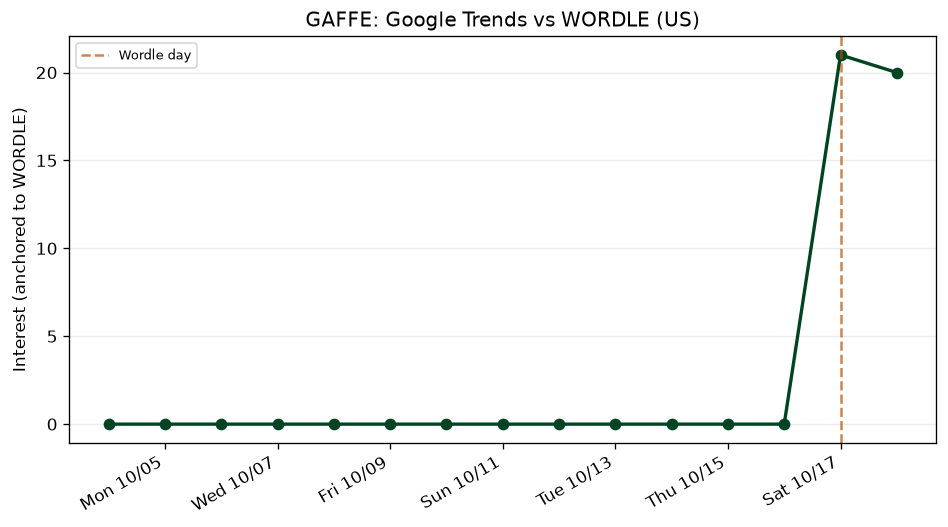
To measure curiosity without relying on raw search counts, we project lookups onto a shared scale anchored directly to daily searches for "WORDLE." Before the puzzle landed, background interest was nearly non-existent, sitting at a quiet baseline of L ≈ 0. On game day, lookup interest leapt to H ≈ 21 on that shared scale—yielding a dramatic spike of roughly 2100%. Because all words are calibrated against the same fixed baseline rather than individual isolated charts, we know this surge comfortably cleared our obscurity gate, surpassing the 70th percentile bar of 1460% drawn from our historical dataset (n ≈ 59).
If that pair of center consonants gave your streak a bit of trouble, take heart—every seasoned solver stumbles once in a while. May tomorrow's five letters be gentle on your grid, and happy puzzling!
Where it ranks
GAFFE is ranked number 15 on our list of 68 words that we have looked at since March 1, 2026. It falls right between DOWDY and ELEGY.
- CAROM — Wordle Apr 10, 2026 (+6800%, H=68) — obscurity post
- ETUDE — Wordle May 31, 2026 (+5000%, H=50) — obscurity post
- COPSE — Wordle Sep 25, 2026 (+4100%, H=41) — obscurity post
- SERIF — Wordle Mar 23, 2026 (+4000%, H=40) — obscurity post
- OVATE — Wordle Jun 22, 2026 (+3800%, H=38) — obscurity post
- UMBRA — Wordle May 8, 2026 (+3800%, H=38) — obscurity post
- USURY — Wordle Oct 2, 2026 (+3700%, H=37) — obscurity post
- ELFIN — Wordle Apr 13, 2026 (+3200%, H=32) — obscurity post
- WREST — Wordle Oct 20, 2026 (+3000%, H=30) — obscurity post
- CUBIT — Wordle Apr 16, 2026 (+2800%, H=28) — obscurity post
How we measure Wordle “obscurity” (plain English + careful math)
The everyday idea
When a hard Wordle answer drops, people google it. A more obscure answer tends to send more people to the search box, relative to how often that word is usually searched.
We’re trying to measure that “sudden rush of lookups,” then keep a leaderboard of the most obscure answers we’ve scored since March 1, 2026. This post is about GAFFE; right now the leader on that list is CAROM.
The catch with Google Trends
Google Trends does not tell us “12,000 people searched GAFFE today.”
It gives a relative score from 0 to 100 inside whatever search you asked for. Think of it like grading on a curve for that one chart only:
- The busiest thing in that chart gets 100
- Everything else is scaled down from that peak
So if you looked up GAFFE alone, Trends would often stretch GAFFE so its busiest day is 100 — even if, in real life, far fewer people searched it than searched a huge term like WORDLE. The same would happen for CAROM on its own private chart. Those two solo charts would not share a yardstick, so you couldn’t fairly ask which Wordle day really drew more lookups.
Our fix: put every word on the same yardstick
We always compare each Wordle answer to a fixed reference word: WORDLE.
- First we ask Trends for WORDLE alone. That becomes our shared ruler (the “WORDLE chart”).
- Then we ask Trends for WORDLE + the answer together (for this post: WORDLE + GAFFE; for the current leader: WORDLE + CAROM). In each joint chart, the two words are already drawn to the same scale.
- We then translate the answer’s line onto the shared WORDLE ruler, day by day.
In words:
“On this day, GAFFE was X% as busy as WORDLE in the joint chart; map that onto how busy WORDLE looks on our master WORDLE chart.”
After that translation, GAFFE’s height and CAROM’s height mean something comparable. If CAROM’s Wordle-day height is bigger than GAFFE’s, that really does look like more lookup activity relative to WORDLE, not just “both hit the top of their own private chart.”
We call that shared-scale score the Obscurity Index series.
The spike math (the only formula that matters)
For one answer word on its Wordle day:
- L = the quietest day before the Wordle day (on the shared WORDLE scale)
- H = interest on the Wordle day (same scale)
Then:
Spike % = (H − L) ÷ max(L, 1) × 100
Careful reading of that:
- If interest goes from 2 to 22, spike = (22−2)/2 × 100 = 1000% (“ten times the quiet baseline, as a percent increase”).
- If the quiet baseline is 0, we pretend the baseline is 1 so we don’t divide by zero. That’s why a jump from 0→11 becomes 1100%, not infinity — which is the kind of jump GAFFE can show on this scale.
So the percentage is “how big was the jump from the pre-Wordle lull to Wordle day?”
H itself is the “how tall was that Wordle-day spike on the WORDLE yardstick?” number we also show on the list.
A word can look obscure either because the jump is huge, or because H is large (lots of lookups vs WORDLE), or both. We rank by the spike %, and we display H so volume isn’t invisible. That’s how CAROM can sit above GAFFE on the list even though both were sticky Wordle days.
What has to be true before we write a blog post
We don’t post about every Wordle answer. We post when:
- Trends data exists
- Wordle-day interest isn’t zero
- The Wordle day really is the peak in the window we looked at (so we’re not celebrating a random other spike)
- The spike clears a high bar: about the 70th percentile of our earlier scores on this same WORDLE-anchored scale (roughly: “enters or nearly enters our top 10 most obscure answers”)
The “Where it ranks” section
That section above is built live when you open the page:
- only words scored on this WORDLE-anchored method
- sorted most obscure first
- one short sentence about GAFFE’s place
- then the shared list (CAROM at the top right now, with GAFFE highlighted here)
When a new obscure answer lands and reshuffles the order, this page updates with it. No frozen snapshot of an old ranking.
One-sentence summary
We map every Wordle answer onto a shared WORDLE scale, measure the jump from “quiet before Wordle” to “Wordle day,” and only blog the ones that clear a top-tier obscurity bar — with a live leaderboard so GAFFE’s place next to CAROM (and whoever comes next) stays honest.