
As a retired professor who still loves a good linguistic puzzle, I spent some time this morning reviewing last week's Wordle words and their corresponding Google Trends obscurity spikes. There is a quiet joy in analyzing how players, after struggling with a particularly difficult challenge, immediately head to Google to search for the word to see what it actually means. It is a fascinating window into our collective vocabulary gaps, showing us exactly where the daily play of the game nudges us to expand our horizons.
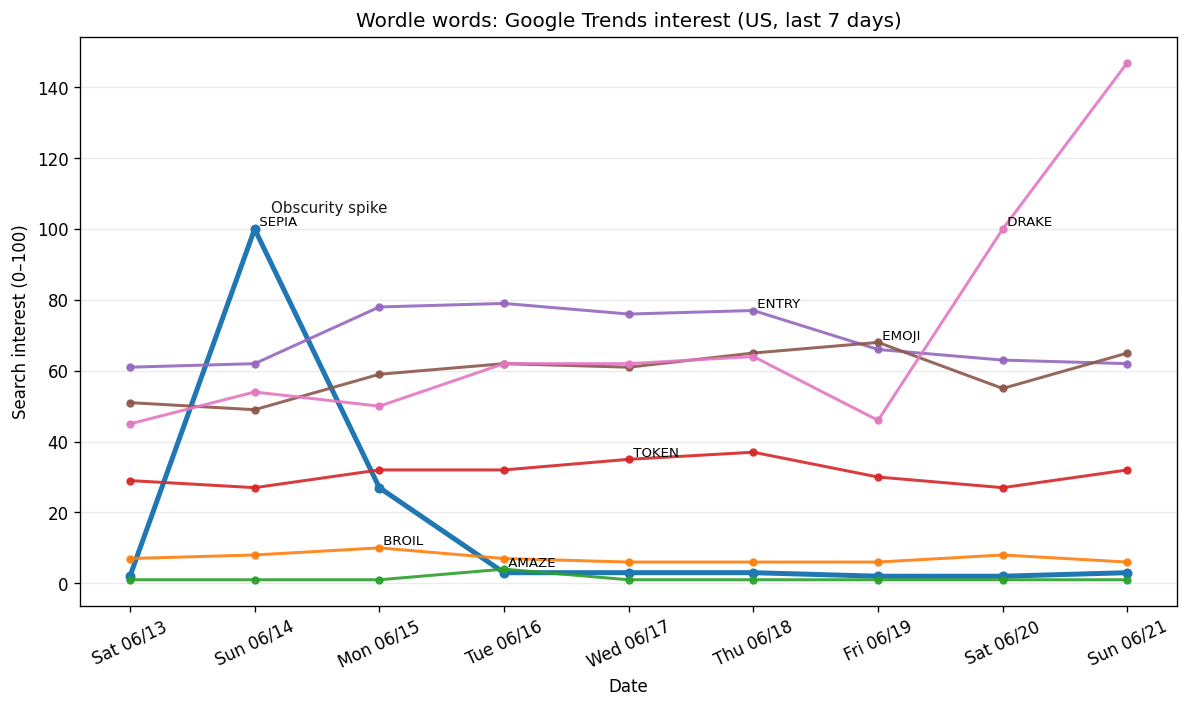
About this chart. Each line is one Wordle answer’s search interest in the United States over the past seven days (Google Trends “Interest over time”). Values are on Google’s 0–100 scale, so you can compare how often people searched each word relative to the others this week.
How the Spike % is calculated. For each word we take the quietest day in that window (the lowest point on its line) as its usual level for the week, and the busiest day (the highest point) as the peak. The spike is the percentage increase from that low to that high: (peak − low) ÷ max(low, 1) × 100. If the week’s low is zero, we divide by 1 instead of 0 so the spike still measures how much interest rose from the floor to the peak. A larger spike means searches jumped more sharply when that word was the daily answer.
Before we examine the table, let us look at a curious mathematical phenomenon regarding how we measure these spikes. You see, a word's search spike is calculated as a percentage increase from its baseline. This means a word with almost no daily search volume can easily outshine a word with massive, steady background interest, even if the latter saw more raw search volume during the game. For instance, DRAKE actually saw the largest raw chart swing this week, jumping 102 points from a baseline of 45 to a peak of 147. Yet, because of its high baseline—likely driven by music fans or nature enthusiasts—its relative spike was a modest 227%. Contrast that with SEPIA, which sits quietly at a baseline of 2 until the daily challenge thrusts it into the spotlight, driving a 98-point jump to a peak of 100. Because it started so low, its relative spike is a staggering 4900%. It is a beautiful demonstration of how relative metrics highlight sudden obscurity over steady, everyday usage.
As a brief side note for those who enjoy looking at how letters can be rearranged, this week's list gave us a couple of delightful anagram opportunities. The letters in SEPIA can be scrambled to spell PAISE (a unit of currency in India), while DRAKE can easily be jumbled into RAKED.
This week’s words
| Date | Word | Spike | Meaning |
|---|---|---|---|
| Sun, Jun 14 | SEPIA | +4900% | (n. pl. sepias) A reddish-brown pigment made from the inky fluid of cuttlefish. (n. pl. sepias) A dark reddish-brown color, often seen in old photographs. |
| Mon, Jun 15 | BROIL | +67% | (v.) To cook food directly under or over a heat source. (v.) To make or become extremely hot. |
| Tue, Jun 16 | AMAZE | +300% | (v.) to overwhelm with surprise or wonder. |
| Wed, Jun 17 | TOKEN | +37% | (v.) To serve as a sign or symbol of; to indicate. (n. pl. tokens) A piece resembling a coin, used as a substitute for money or for specific purposes. (n. pl. tokens) A sign or symbol of something; an |
| Thu, Jun 18 | ENTRY | +30% | The plural form of the noun 'fiancé', referring to two or more people who are engaged to be married. |
| Fri, Jun 19 | EMOJI | +39% | (n. pl. EMOJIS) A small digital image or icon used to express an idea or emotion in electronic communication. |
| Sat, Jun 20 | DRAKE | +227% | (n. pl. drakes) A male duck. (n. pl. drakes) A dragon. |
Obscurity winner
Using search interest in the US over the last seven days, I looked for the biggest “obscurity spikes”—words that saw the largest percentage jump in searches when they appeared as the answer in the daily word puzzle. This week's standout was SEPIA, with search interest spiking by about 4900% from its usual baseline: most days this week it hovered around 2 or so on the search scale, and then it jumped up to about 100 when it hit the grid. For a mid-pack difficulty word, that spike is a real mountain on the word-game charts.
Our runner-up, AMAZE, also saw a notable 300% spike, though it rose from a tiny baseline of 1 to a peak of 4, demonstrating how even common words can experience a minor tremor when placed in a competitive context.
Whether you aced every grid or learned a new word or two, I hope you had fun. Word games ought to feel like a treat, not a test. If you'd like to explore the trends yourself, you can see the full comparison below and turn it into your own little word-search challenge.
View these words on Google Trends (US, last 7 days)
The top 5 most obscure words used in Wordle, since I started doing this March 1, 2026, are still CAROM (+70000%), DOWDY (+36700%), ELFIN (+35900%), CUBIT (+33500%), CHUCK (+32000%).
Word game sentence
We were amazed to watch the drake splash in the sepia-toned pond, a token of peace before we returned to the kitchen to broil our dinner and log our daily entry into the emoji-filled family blog.
From a stylistic standpoint, this sentence flows surprisingly well despite the disparate nature of its components. Integrating modern digital slang like "emoji" alongside the nostalgic warmth of "sepia" and the ornithological specificity of "drake" creates a rather eclectic narrative. It is a testament to the delightful unpredictability of the daily Wordle challenge, a game that keeps our minds sharp and our vocabularies delightfully scrambled.
For Math Nerds
What this section is for. It documents exactly how each week’s spike numbers were computed from the scaled Google Trends series, so curious readers can verify the arithmetic.
Trends window. We request a custom date range 2026-06-13 2026-06-21 (US), which is the Wordle week plus one day before and after so the chart has a little context on each side. The anchor keyword for cross-request scaling is SEPIA (the first day’s answer, in chronological order).
Scaling across separate requests. Google Trends only returns relative 0–100 values within one request. We fetch each answer in its own request paired with that anchor, then rescale each day so the anchor’s curve matches the anchor series from the first request. Concretely: scaledword(d) = rawword(d) × base_anchor(d) / rawanchor(d) when rawanchor(d) > 0, else 0.
Spike % for one word. Let L be the minimum and H the maximum of that word’s scaled daily values over the window (see table below). Define spike% = (H − L) / max(L, 1) × 100 when L ≠ H, otherwise 0%. Using max(L, 1) avoids division by zero when L = 0.
Percentage spike vs. raw chart swing. This week’s top spike% belongs to SEPIA (H − L = 98 on the scaled series), but the largest absolute rise H − L belongs to DRAKE (102). A very low baseline L inflates percentage spike even when the line does not climb as far in chart points as another word’s line.
SEPIA (Wordle day 2026-06-14)
Scaled interest by date; spike for rankings uses +4900% from this series.
| Date | Interest |
|---|---|
| 2026-06-13 | 2 |
| 2026-06-14 | 100 |
| 2026-06-15 | 27 |
| 2026-06-16 | 3 |
| 2026-06-17 | 3 |
| 2026-06-18 | 3 |
| 2026-06-19 | 2 |
| 2026-06-20 | 2 |
| 2026-06-21 | 3 |
- L = 2 on: 2026-06-13, 2026-06-19, 2026-06-20
- H = 100 on: 2026-06-14
- Denominator
max(L, 1)= 2 - (100 - 2) / 2 * 100 = 4900.0000%
BROIL (Wordle day 2026-06-15)
Scaled interest by date; spike for rankings uses +67% from this series.
| Date | Interest |
|---|---|
| 2026-06-13 | 7 |
| 2026-06-14 | 8 |
| 2026-06-15 | 10 |
| 2026-06-16 | 7 |
| 2026-06-17 | 6 |
| 2026-06-18 | 6 |
| 2026-06-19 | 6 |
| 2026-06-20 | 8 |
| 2026-06-21 | 6 |
- L = 6 on: 2026-06-17, 2026-06-18, 2026-06-19, 2026-06-21
- H = 10 on: 2026-06-15
- Denominator
max(L, 1)= 6 - (10 - 6) / 6 * 100 = 66.6667%
AMAZE (Wordle day 2026-06-16)
Scaled interest by date; spike for rankings uses +300% from this series.
| Date | Interest |
|---|---|
| 2026-06-13 | 1 |
| 2026-06-14 | 1 |
| 2026-06-15 | 1 |
| 2026-06-16 | 4 |
| 2026-06-17 | 1 |
| 2026-06-18 | 1 |
| 2026-06-19 | 1 |
| 2026-06-20 | 1 |
| 2026-06-21 | 1 |
- L = 1 on: 2026-06-13, 2026-06-14, 2026-06-15, 2026-06-17, 2026-06-18, 2026-06-19, 2026-06-20, 2026-06-21
- H = 4 on: 2026-06-16
- Denominator
max(L, 1)= 1 - (4 - 1) / 1 * 100 = 300.0000%
TOKEN (Wordle day 2026-06-17)
Scaled interest by date; spike for rankings uses +37% from this series.
| Date | Interest |
|---|---|
| 2026-06-13 | 29 |
| 2026-06-14 | 27 |
| 2026-06-15 | 32 |
| 2026-06-16 | 32 |
| 2026-06-17 | 35 |
| 2026-06-18 | 37 |
| 2026-06-19 | 30 |
| 2026-06-20 | 27 |
| 2026-06-21 | 32 |
- L = 27 on: 2026-06-14, 2026-06-20
- H = 37 on: 2026-06-18
- Denominator
max(L, 1)= 27 - (37 - 27) / 27 * 100 = 37.0370%
ENTRY (Wordle day 2026-06-18)
Scaled interest by date; spike for rankings uses +30% from this series.
| Date | Interest |
|---|---|
| 2026-06-13 | 61 |
| 2026-06-14 | 62 |
| 2026-06-15 | 78 |
| 2026-06-16 | 79 |
| 2026-06-17 | 76 |
| 2026-06-18 | 77 |
| 2026-06-19 | 66 |
| 2026-06-20 | 63 |
| 2026-06-21 | 62 |
- L = 61 on: 2026-06-13
- H = 79 on: 2026-06-16
- Denominator
max(L, 1)= 61 - (79 - 61) / 61 * 100 = 29.5082%
EMOJI (Wordle day 2026-06-19)
Scaled interest by date; spike for rankings uses +39% from this series.
| Date | Interest |
|---|---|
| 2026-06-13 | 51 |
| 2026-06-14 | 49 |
| 2026-06-15 | 59 |
| 2026-06-16 | 62 |
| 2026-06-17 | 61 |
| 2026-06-18 | 65 |
| 2026-06-19 | 68 |
| 2026-06-20 | 55 |
| 2026-06-21 | 65 |
- L = 49 on: 2026-06-14
- H = 68 on: 2026-06-19
- Denominator
max(L, 1)= 49 - (68 - 49) / 49 * 100 = 38.7755%
DRAKE (Wordle day 2026-06-20)
Scaled interest by date; spike for rankings uses +227% from this series.
| Date | Interest |
|---|---|
| 2026-06-13 | 45 |
| 2026-06-14 | 54 |
| 2026-06-15 | 50 |
| 2026-06-16 | 62 |
| 2026-06-17 | 62 |
| 2026-06-18 | 64 |
| 2026-06-19 | 46 |
| 2026-06-20 | 100 |
| 2026-06-21 | 147 |
- L = 45 on: 2026-06-13
- H = 147 on: 2026-06-21
- Denominator
max(L, 1)= 45 - (147 - 45) / 45 * 100 = 226.6667%
Ranking order sorts words by spike% descending; ties are broken only by Python’s stable sort (original dict iteration order), not by puzzle date.