
As a retired professor who still grades the world's vocabulary on a curve, I spent some time this morning reviewing last week's Wordle words and analyzing their Google Trends obscurity spikes. There is a quiet joy in studying these data points; I love picturing players who, after wrestling with a particularly stubborn daily challenge, immediately head to Google to discover what on earth they just spelled. It is a fascinating window into how we play and learn in real time.
When we look at how these words perform, we are not just looking at a simple list; we are looking at how a single word game can scramble our collective search habits. For instance, did you know that some of these answers are secret anagram puzzles waiting to be solved? If you jumble the letters of ALIBI, you can spell BIALI (that delicious, onion-filled roll), while SCOOP easily rearranges into COOPS. It is a lovely reminder of how letters can dance around when we let them.
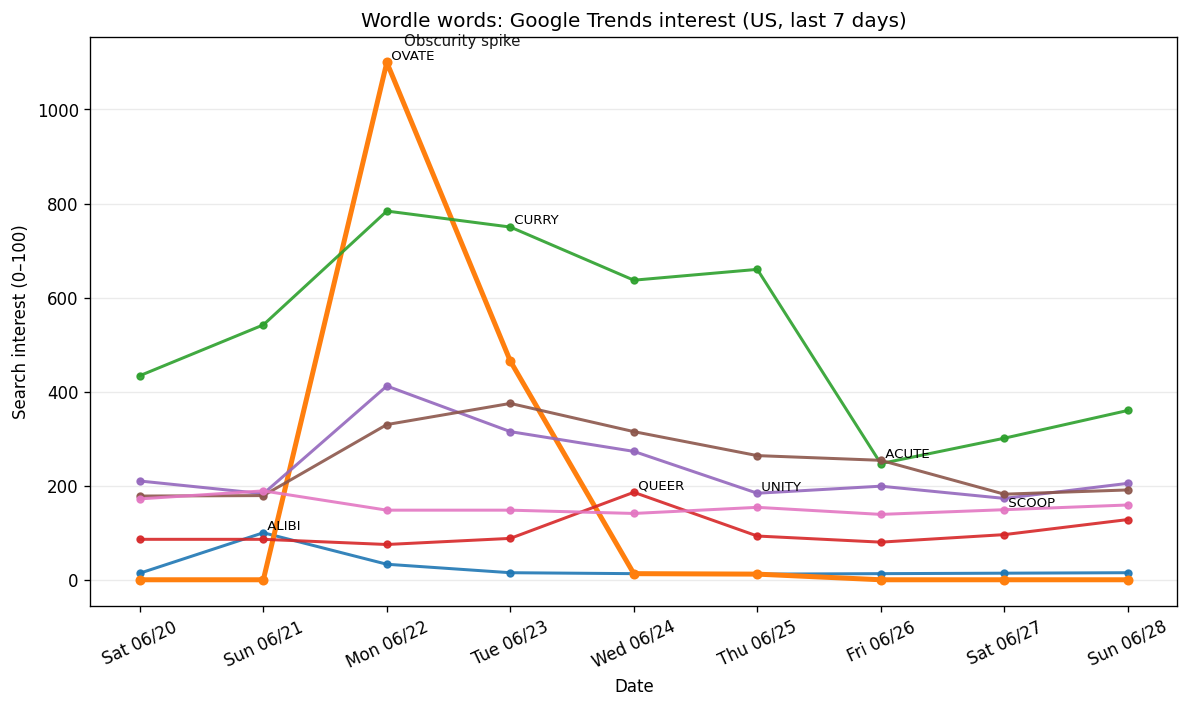
About this chart. Each line is one Wordle answer’s search interest in the United States over the past seven days (Google Trends “Interest over time”). Values are on Google’s 0–100 scale, so you can compare how often people searched each word relative to the others this week.
How the Spike % is calculated. For each word we take the quietest day in that window (the lowest point on its line) as its usual level for the week, and the busiest day (the highest point) as the peak. The spike is the percentage increase from that low to that high: (peak − low) ÷ max(low, 1) × 100. If the week’s low is zero, we divide by 1 instead of 0 so the spike still measures how much interest rose from the floor to the peak. A larger spike means searches jumped more sharply when that word was the daily answer.
This week’s words
| Date | Word | Spike | Meaning |
|---|---|---|---|
| Sun, Jun 21 | ALIBI | +733% | (v.) To offer an excuse or explanation for. (n. pl. alibis) A claim or proof that one was elsewhere when an event took place. (n. pl. alibis) An excuse, especially one used to avoid blame. |
| Mon, Jun 22 | OVATE | +110000% | (adj.) Having an oval or egg-shaped form. (adv.) In an ovate manner; in an egg-shaped way. |
| Tue, Jun 23 | CURRY | +217% | (v.) To dress or prepare tanned leather. (n. pl. curries) A dish of meat, vegetables, or fish cooked in a spicy sauce. (v.) To flavor or cook food with curry powder or paste. |
| Wed, Jun 24 | QUEER | +148% | (adj. queerer, queerest) Strange or odd; unusual. (v. queered, queering, queers) To spoil or ruin. |
| Thu, Jun 25 | UNITY | +138% | (n. pl. UNITIES) The state of being one single entity. (n. pl. UNITIES) The state of being in agreement or harmony; concord. |
| Fri, Jun 26 | ACUTE | +111% | (adj. acuter, acutest) Marked by sharpness or severity; very intense. (adj.) (Of an angle) less than 90 degrees. (n. pl. acutes) A type of accent mark. |
| Sat, Jun 27 | SCOOP | +36% | (v.) To take up or out with a scoop or a similar tool. (n. pl. scoops) A deep, spoon-shaped tool used for taking up soft or loose material. (n. pl. scoops) An exclusive news story published by one rep |
Obscurity winner
Using search interest in the US over the last seven days, I looked for the biggest “obscurity spikes”—words that saw the largest percentage jump in searches when they appeared as the answer in the daily word puzzle. This week's standout was OVATE, with search interest spiking by about 110000% from its usual baseline: it usually sat near the bottom of the search charts, and then it jumped up to about 1100 when it hit the grid. For a mid-pack difficulty word, that spike is a real mountain on the word-game charts.
As an analyst, I must point out a delightful quirk in how we calculate these spikes. The percentage spike heavily rewards a relative change from a rock-bottom baseline. For example, while the botanical term OVATE achieved both the highest percentage spike and the largest raw chart swing of 1100, look at a word like CURRY. It saw a massive absolute chart swing of 537 points, yet its spike was a modest 217% because it started with a high baseline of 247. This makes intuitive sense: a popular culinary term maintains steady background interest, whereas a specialist term like OVATE remains virtually unsearched until a national puzzle game suddenly thrusts it into the spotlight.
Whether you aced every grid or learned a new word or two, I hope you had fun. Word games ought to feel like a treat, not a test. If you'd like to explore the trends yourself, you can see the full comparison below and turn it into your own little word-search challenge.
View these words on Google Trends (US, last 7 days)
This week nudged the all-time Wordle obscurity leaderboard: OVATE muscled its way in, and the top five most obscure answers I've seen so far are now OVATE (+110000%), CAROM (+70000%), DOWDY (+36700%), ELFIN (+35900%), CUBIT (+33500%).
Word game sentence
While enjoying a curried lunch, the detective acutely noted that the suspect's ovately sketched alibi possessed a queer lack of unity, a detail she quickly scooped up for her files.
Syntactically, weaving botanical geometry, legal excuses, and culinary arts into a single sentence is always a bit of a creative jumble, but the narrative flow holds up surprisingly well. It is a testament to how these daily challenges expand our linguistic horizons, turning a simple five-letter play session into an opportunity to unite disparate corners of our vocabulary.
For Math Nerds
What this section is for. It documents exactly how each week’s spike numbers were computed from the scaled Google Trends series, so curious readers can verify the arithmetic.
Trends window. We request a custom date range 2026-06-20 2026-06-28 (US), which is the Wordle week plus one day before and after so the chart has a little context on each side. The anchor keyword for cross-request scaling is ALIBI (the first day’s answer, in chronological order).
Scaling across separate requests. Google Trends only returns relative 0–100 values within one request. We fetch each answer in its own request paired with that anchor, then rescale each day so the anchor’s curve matches the anchor series from the first request. Concretely: scaledword(d) = rawword(d) × base_anchor(d) / rawanchor(d) when rawanchor(d) > 0, else 0.
Spike % for one word. Let L be the minimum and H the maximum of that word’s scaled daily values over the window (see table below). Define spike% = (H − L) / max(L, 1) × 100 when L ≠ H, otherwise 0%. Using max(L, 1) avoids division by zero when L = 0.
ALIBI (Wordle day 2026-06-21)
Scaled interest by date; spike for rankings uses +733% from this series.
| Date | Interest |
|---|---|
| 2026-06-20 | 14 |
| 2026-06-21 | 100 |
| 2026-06-22 | 33 |
| 2026-06-23 | 15 |
| 2026-06-24 | 13 |
| 2026-06-25 | 12 |
| 2026-06-26 | 13 |
| 2026-06-27 | 14 |
| 2026-06-28 | 15 |
- L = 12 on: 2026-06-25
- H = 100 on: 2026-06-21
- Denominator
max(L, 1)= 12 - (100 - 12) / 12 * 100 = 733.3333%
OVATE (Wordle day 2026-06-22)
Scaled interest by date; spike for rankings uses +110000% from this series.
| Date | Interest |
|---|---|
| 2026-06-20 | 0 |
| 2026-06-21 | 0 |
| 2026-06-22 | 1100 |
| 2026-06-23 | 465 |
| 2026-06-24 | 13 |
| 2026-06-25 | 12 |
| 2026-06-26 | 0 |
| 2026-06-27 | 0 |
| 2026-06-28 | 0 |
- L = 0 on: 2026-06-20, 2026-06-21, 2026-06-26, 2026-06-27, 2026-06-28
- H = 1100 on: 2026-06-22
- Denominator
max(L, 1)= 1 - (1100 - 0) / 1 * 100 = 110000.0000%
CURRY (Wordle day 2026-06-23)
Scaled interest by date; spike for rankings uses +217% from this series.
| Date | Interest |
|---|---|
| 2026-06-20 | 434 |
| 2026-06-21 | 542 |
| 2026-06-22 | 784 |
| 2026-06-23 | 750 |
| 2026-06-24 | 637 |
| 2026-06-25 | 660 |
| 2026-06-26 | 247 |
| 2026-06-27 | 301 |
| 2026-06-28 | 360 |
- L = 247 on: 2026-06-26
- H = 784 on: 2026-06-22
- Denominator
max(L, 1)= 247 - (784 - 247) / 247 * 100 = 217.4089%
QUEER (Wordle day 2026-06-24)
Scaled interest by date; spike for rankings uses +148% from this series.
| Date | Interest |
|---|---|
| 2026-06-20 | 86 |
| 2026-06-21 | 86 |
| 2026-06-22 | 75 |
| 2026-06-23 | 88 |
| 2026-06-24 | 186 |
| 2026-06-25 | 93 |
| 2026-06-26 | 80 |
| 2026-06-27 | 96 |
| 2026-06-28 | 128 |
- L = 75 on: 2026-06-22
- H = 186 on: 2026-06-24
- Denominator
max(L, 1)= 75 - (186 - 75) / 75 * 100 = 148.0000%
UNITY (Wordle day 2026-06-25)
Scaled interest by date; spike for rankings uses +138% from this series.
| Date | Interest |
|---|---|
| 2026-06-20 | 210 |
| 2026-06-21 | 183 |
| 2026-06-22 | 412 |
| 2026-06-23 | 315 |
| 2026-06-24 | 273 |
| 2026-06-25 | 184 |
| 2026-06-26 | 199 |
| 2026-06-27 | 173 |
| 2026-06-28 | 205 |
- L = 173 on: 2026-06-27
- H = 412 on: 2026-06-22
- Denominator
max(L, 1)= 173 - (412 - 173) / 173 * 100 = 138.1503%
ACUTE (Wordle day 2026-06-26)
Scaled interest by date; spike for rankings uses +111% from this series.
| Date | Interest |
|---|---|
| 2026-06-20 | 178 |
| 2026-06-21 | 179 |
| 2026-06-22 | 330 |
| 2026-06-23 | 375 |
| 2026-06-24 | 315 |
| 2026-06-25 | 264 |
| 2026-06-26 | 254 |
| 2026-06-27 | 182 |
| 2026-06-28 | 191 |
- L = 178 on: 2026-06-20
- H = 375 on: 2026-06-23
- Denominator
max(L, 1)= 178 - (375 - 178) / 178 * 100 = 110.6742%
SCOOP (Wordle day 2026-06-27)
Scaled interest by date; spike for rankings uses +36% from this series.
| Date | Interest |
|---|---|
| 2026-06-20 | 172 |
| 2026-06-21 | 189 |
| 2026-06-22 | 148 |
| 2026-06-23 | 148 |
| 2026-06-24 | 141 |
| 2026-06-25 | 154 |
| 2026-06-26 | 139 |
| 2026-06-27 | 149 |
| 2026-06-28 | 159 |
- L = 139 on: 2026-06-26
- H = 189 on: 2026-06-21
- Denominator
max(L, 1)= 139 - (189 - 139) / 139 * 100 = 35.9712%
Ranking order sorts words by spike% descending; ties are broken only by Python’s stable sort (original dict iteration order), not by puzzle date.