
Greetings, fellow word enthusiasts! It's Gramma Ana here, back to dissect another week's worth of Wordle puzzles. As a linguaphile and data observer, I always find it fascinating to track the digital footprints left by players after a particularly knotty word challenge. This week, we're diving into the Google Trends obscurity spikes for the words presented between March 15th and 21st, 2026, specifically looking at how many of you, after wrestling with a tricky word scramble, turned to the search bar to unravel its meaning. It's a delightful peek into the collective curiosity sparked by this engaging word game.
This week’s words
| Date | Word | Spike | Meaning |
|---|---|---|---|
| Sun, Mar 15 | GRADE | +79% | to arrange in steps or degrees [v GRADED, GRADES, GRADING] : GRADABLE [adj], GRADATION [n], GRADER [n] |
| Mon, Mar 16 | DRAMA | +48% | a composition written for theatrical performance [n DRAMAS] |
| Tue, Mar 17 | CLASP | +100% | to embrace tightly [v CLASPED, CLASPING, CLASPS, CLASPT] : CLASPER [n] |
| Wed, Mar 18 | AMPLY | +30% | in an {ample=adj} manner [adv] |
| Thu, Mar 19 | REHAB | +100% | to restore to a good condition [v REHABBED, REHABBING, REHABS] : REHABBER [n] |
| Fri, Mar 20 | OASIS | +42% | a green area in a desert region [n OASES] |
| Sat, Mar 21 | SLICK | +57% | smooth and slippery [adj SLICKER, SLICKEST] : SLICKLY [adv], SLICKNESS [n] / to make slick [v SLICKED, SLICKING, SLICKS] |
Obscurity winner
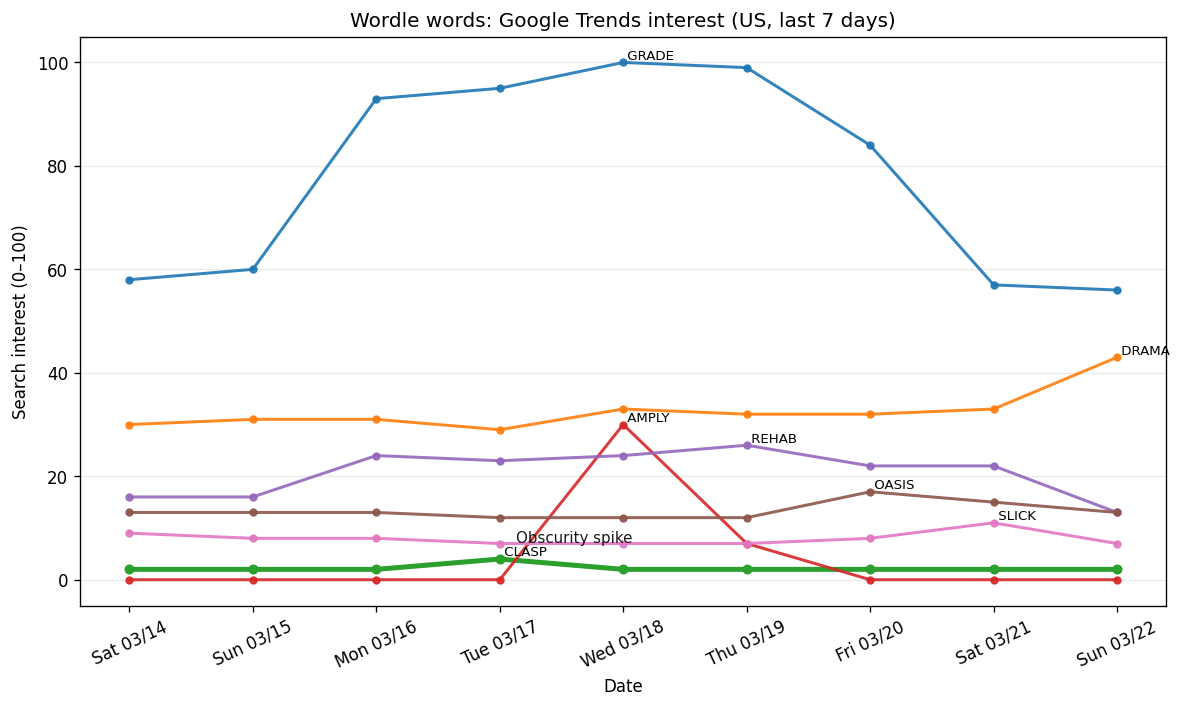
Analyzing search interest in the US across the past seven days, my focus was on identifying the most significant “obscurity spikes”—those words that triggered the largest percentage increase in Google searches upon their appearance in the daily word puzzle. This week's clear winner in the "make-you-look-it-up" challenge was CLASP. Its search interest surged by a notable 100% from its typical baseline. While its absolute peak of 4 from a baseline of 2 might seem modest, it represents a doubling of curiosity, suggesting that for many, this word presented a slight jumble in their mental lexicon, prompting a quick search to confirm its meaning or usage. It’s a classic example of how a seemingly common word can still throw a curveball in a word game.
Not far behind CLASP in generating search interest was REHAB, also experiencing a substantial 100% spike from its baseline. Its search volume doubled from approximately 13 to 26, indicating that this common abbreviation, when presented as a standalone five-letter word in the daily word game, still prompted a significant number of players to confirm its definition or spelling. It's a testament to how even familiar terms can become a mini-challenge when isolated in the grid.
On a linguistic side note, some of this week's words offered a delightful extra layer of play for those who enjoy word puzzles. For instance, CLASP can rearrange into "CLAPS" and "SCALP," while SLICK forms "LICKS." These little anagrammatic relationships remind us that every Wordle word is a tiny scramble of letters with hidden potential, adding another dimension to the game for the truly observant.
Whether you aced every grid or learned a new word or two, I hope you had fun. Word games ought to feel like a treat, not a test. If you'd like to explore the trends yourself, you can see the full comparison below and turn it into your own little word-search challenge.
View these words on Google Trends (US, last 7 days)
The top 5 most obscure words used in Wordle, since I started doing this March 1, 2026, are still GUNKY (+11950%), SHOAL (+11700%), HASTY (+800%), HYDRA (+681%), GUAVA (+335%).
Word game sentence
The graded drama of the desert oasis, amply rehabbed, required a slick clasp to secure its precious contents.
This sentence, while a bit contrived, demonstrates the versatility of English vocabulary. The challenge of weaving together such disparate concepts—from the theatrical 'drama' to the practical 'rehabbed'—into a coherent narrative often results in a somewhat artificial construction. However, it serves to highlight the rich derivational morphology present in the words we encounter daily, even within the confines of a simple word game. It's a fun linguistic exercise, much like the Wordle game itself, that encourages a deeper appreciation for the nuances of language.