
As the calendar turns another page, I've once again delved into the linguistic aftermath of last week's Wordle words, specifically tracking their Google Trends obscurity spikes. It's always fascinating to observe how a particularly tricky daily challenge can send players scrambling to their search engines, eager to understand the meaning of a word that just stumped their carefully honed vocabulary. This analytical play on post-game curiosity offers a unique window into collective lexical knowledge.
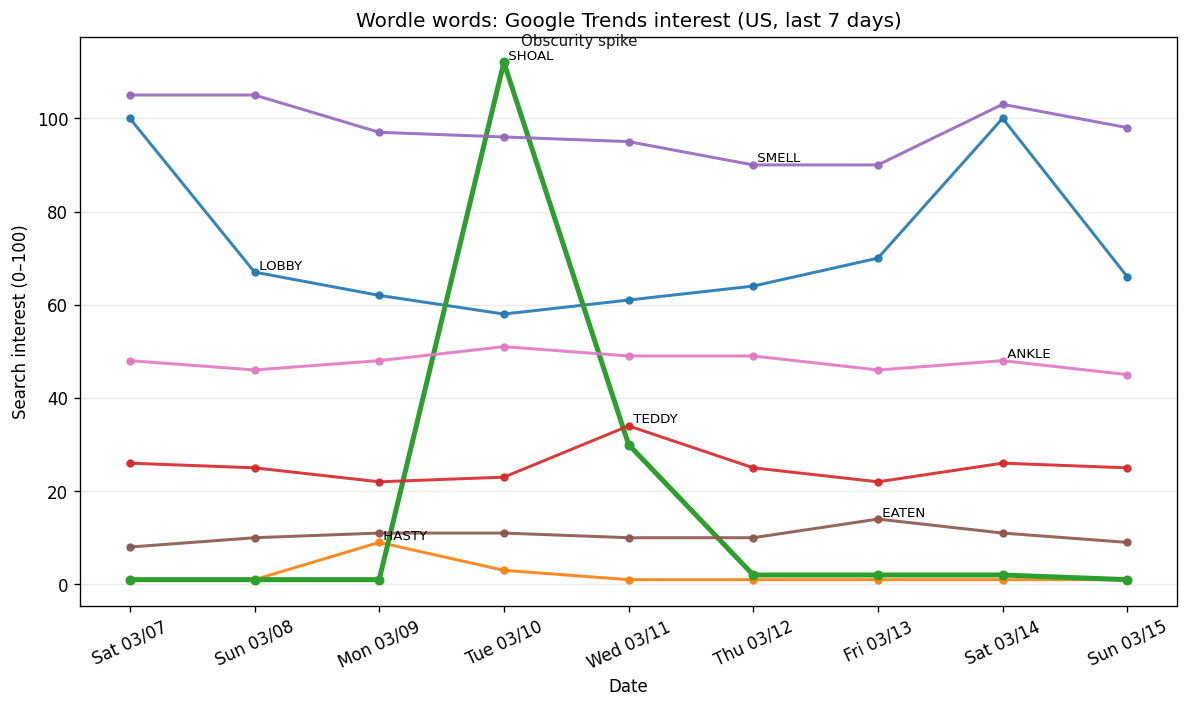
About this chart. Each line is one Wordle answer’s search interest in the United States over the past seven days (Google Trends “Interest over time”). Values are on Google’s 0–100 scale, so you can compare how often people searched each word relative to the others this week.
How the Spike % is calculated. For each word we take the quietest day in that window (the lowest point on its line) as its usual level for the week, and the busiest day (the highest point) as the peak. The spike is the percentage increase from that low to that high: (peak − low) ÷ max(low, 1) × 100. If the week’s low is zero, we divide by 1 instead of 0 so the spike still measures how much interest rose from the floor to the peak. A larger spike means searches jumped more sharply when that word was the daily answer.
This week’s words
| Date | Word | Spike | Meaning |
|---|---|---|---|
| Sun, Mar 8 | LOBBY | +72% | to attempt to influence legislators [v LOBBIED, LOBBIES, LOBBYING] |
| Mon, Mar 9 | HASTY | +800% | {speedy=adj} [adj HASTIER, HASTIEST] : HASTILY [adv], HASTINESS [n] |
| Tue, Mar 10 | SHOAL | +11100% | {shallow=adj} [adj SHOALER, SHOALEST] / to become shallow [v SHOALED, SHOALING, SHOALS] |
| Wed, Mar 11 | TEDDY | +55% | a woman's undergarment [n TEDDIES] |
| Thu, Mar 12 | SMELL | +17% | to perceive by means of the olfactory nerves [v SMELLED, SMELLING, SMELLS, SMELT] : SMELLER [n] |
| Fri, Mar 13 | EATEN | +75% | <eat=v> [v] |
| Sat, Mar 14 | ANKLE | +13% | to {walk=v} [v ANKLED, ANKLES, ANKLING] |
Obscurity winner
My analysis of US search interest over the past seven days reveals the most significant “obscurity spikes”—those words whose appearance as the daily Wordle answer prompted the largest percentage jump in Google searches. This week's undisputed champion of the unexpected was SHOAL, which saw its search interest surge by an astonishing 11100% from its typical baseline. Usually a quiet term, hovering around a search value of 1, it leapt to approximately 112 on the day it became the puzzle's solution. Such a dramatic rise for a word of moderate difficulty underscores the delightful unpredictability of this word game.
Not far behind, though in a different league, was HASTY, which still managed an impressive 800% spike. It's worth noting that SHOAL, beyond its obscurity, also forms a neat anagram with HALOS, a little linguistic jumble that adds another layer of play to the daily challenge.
Regardless of how you fared with this week's word challenges, the underlying joy of the game remains. It's a daily mental workout, not a high-stakes examination. If you are inclined to delve deeper into these trends, the full comparison is available below, offering its own unique data-driven scramble.
View these words on Google Trends (US, last 7 days)
This week's data has indeed reshaped our all-time Wordle obscurity leaderboard. SHOAL has decisively entered the top ranks, making the current top five most obscure answers I've tracked: GUNKY (+27500%), SHOAL (+11100%), HASTY (+800%), HYDRA (+575%), and GUAVA (+335%).
Word game sentence
A hasty teddy bear, having eaten a smelly fish from the shoal, decided to lobby for better seafood, then quietly ankled away.
This sentence, while perhaps a touch whimsical, successfully incorporates a derivative of each Wordle answer from the week. Constructing such a phrase is a delightful linguistic challenge in itself, mirroring the satisfaction of solving the daily word puzzle. It reminds us of the rich interconnectedness of our lexicon, a feature Wordle so brilliantly highlights.