
As an analyst who spent decades in the classroom, I find myself endlessly fascinated by how we interact with our daily word puzzle. Every week, I enjoy reviewing the latest Wordle words and their corresponding Google Trends obscurity spikes. It is a delightful window into human behavior: after struggling with a particularly difficult word game challenge, players routinely head straight to Google to search for the word, eager to discover its precise definition or perhaps to confirm that this odd jumble of letters is indeed a real word. Let us analyze how last week's play unfolded and which terms sent us scrambling to our search engines.
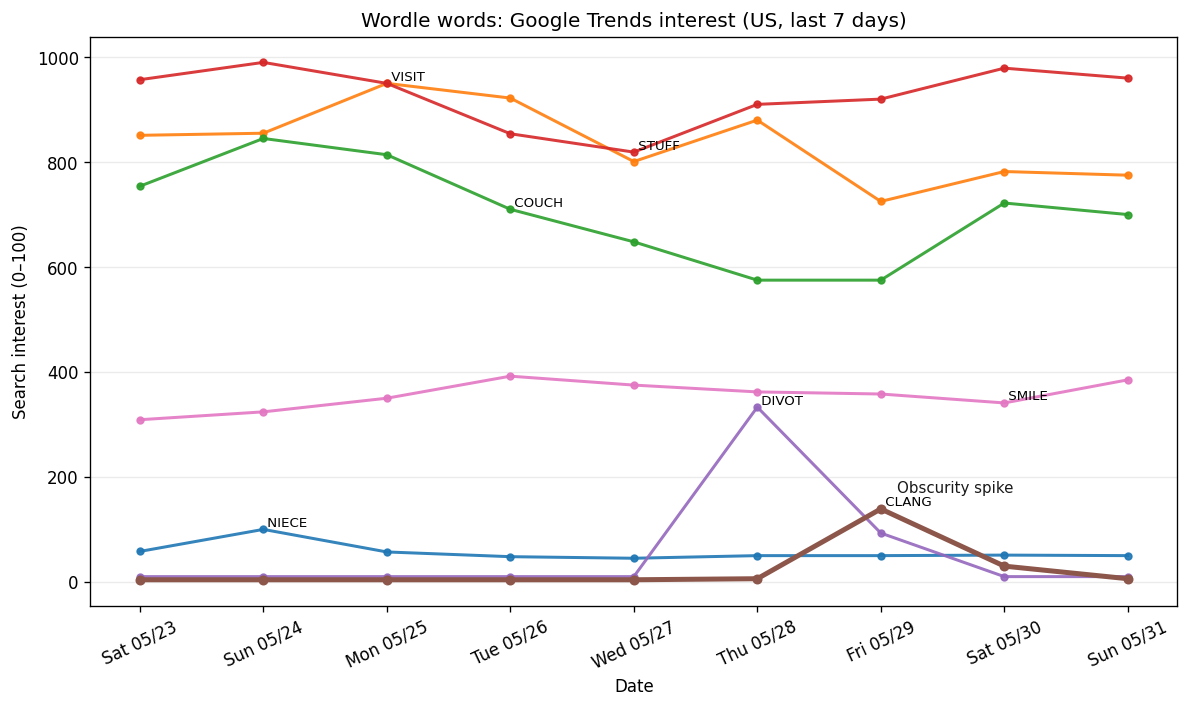
About this chart. Each line is one Wordle answer’s search interest in the United States over the past seven days (Google Trends “Interest over time”). Values are on Google’s 0–100 scale, so you can compare how often people searched each word relative to the others this week.
How the Spike % is calculated. For each word we take the quietest day in that window (the lowest point on its line) as its usual level for the week, and the busiest day (the highest point) as the peak. The spike is the percentage increase from that low to that high: (peak − low) ÷ max(low, 1) × 100. If the week’s low is zero, we divide by 1 instead of 0 so the spike still measures how much interest rose from the floor to the peak. A larger spike means searches jumped more sharply when that word was the daily answer.
This week’s words
| Date | Word | Spike | Meaning |
|---|---|---|---|
| Sun, May 24 | NIECE | +122% | (n. pl. nieces) A daughter of one's brother or sister. |
| Mon, May 25 | VISIT | +31% | (v.) to go or come to see someone or something. (n. pl. visits) An act of going to see someone or something; a temporary stay. |
| Tue, May 26 | COUCH | +47% | (n. pl. couches) A long upholstered seat with a back and arms, for two or more people. (v.) To express or phrase something in words. (v.) To lie down or recline, especially in a hidden or resting posi |
| Wed, May 27 | STUFF | +21% | (v.) to fill or pack tightly. (n.) a collection of things or belongings. (v.) to fill with food. |
| Thu, May 28 | DIVOT | +3230% | (n. pl. divots) A piece of turf dug out of the ground, especially by a golf club. |
| Fri, May 29 | CLANG | +3375% | (v.) To make a loud, ringing metallic sound. (n. pl. clangs) A loud, ringing metallic sound. |
| Sat, May 30 | SMILE | +27% | (v.) to turn up the corners of the mouth, often to show pleasure, amusement, or friendliness. (n. pl. smiles) A facial expression made by turning up the corners of the mouth, typically showing pleasur |
Obscurity winner
Using search interest in the US over the last seven days, I looked for the biggest “obscurity spikes”—words that saw the largest percentage jump in searches when they appeared as the answer in the daily word puzzle. This week's standout was CLANG, with search interest spiking by about 3375% from its usual baseline: most days this week it hovered around 4 or so on the search scale, and then it jumped up to about 139 when it hit the grid. For a mid-pack difficulty word, that spike is a real mountain on the word-game charts.
Our percentage winner, however, tells only half the story. A keen analytical eye will notice that DIVOT actually experienced a much larger raw chart swing, jumping from a baseline of 10 up to a peak of 333 (an absolute difference of 323 points, compared to CLANG's 135). Why does CLANG still top our ranking? It comes down to the math of relative change. Because CLANG started with an incredibly quiet baseline of 4, its relative jump represents a more dramatic proportional surge, whereas DIVOT likely maintains a steady, niche background interest from golf enthusiasts that slightly dampens its percentage spike despite a massive absolute leap when it appeared in the game.
As a side note for those who enjoy a quick word scramble, this week's list contained some lovely anagram opportunities. For instance, the word SMILE can be rearranged into LIMES, MILES, or SLIME, turning our standard daily play into a multi-layered anagram puzzle.
Whether you aced every grid or learned a new word or two, I hope you had fun. Word games ought to feel like a treat, not a test. If you'd like to explore the trends yourself, you can see the full comparison below and turn it into your own little word-search challenge.
View these words on Google Trends (US, last 7 days)
The runner-up in this little word-search race was DIVOT, up about 3230% from its own baseline (from roughly 10 up to 333). Not quite as dramatic in percentage terms, but still a fine little spike for a daily word game.
The top 5 most obscure words used in Wordle, since I started doing this March 1, 2026, are still CAROM (+70000%), DOWDY (+36700%), ELFIN (+35900%), CUBIT (+33500%), and CHUCK (+32000%).
Word game sentence
My smiling niece decided to visit me, but as she stepped onto the porch, she accidentally kicked a divot out of the lawn, dropped her stuffed bag with a loud metallic clang, and collapsed onto the living room couch.
Syntactically, this sentence flows surprisingly well, though packing seven distinct concepts into a single narrative arc always feels slightly forced. It is a testament to the versatility of English that we can weave golf turf, family visits, and metallic noises into one cohesive scene, reminding us why we love the daily challenge of these word games.
For Math Nerds
What this section is for. It documents exactly how each week’s spike numbers were computed from the scaled Google Trends series, so curious readers can verify the arithmetic.
Trends window. We request a custom date range 2026-05-23 2026-05-31 (US), which is the Wordle week plus one day before and after so the chart has a little context on each side. The anchor keyword for cross-request scaling is NIECE (the first day’s answer, in chronological order).
Scaling across separate requests. Google Trends only returns relative 0–100 values within one request. We fetch each answer in its own request paired with that anchor, then rescale each day so the anchor’s curve matches the anchor series from the first request. Concretely: scaledword(d) = rawword(d) × base_anchor(d) / rawanchor(d) when rawanchor(d) > 0, else 0.
Spike % for one word. Let L be the minimum and H the maximum of that word’s scaled daily values over the window (see table below). Define spike% = (H − L) / max(L, 1) × 100 when L ≠ H, otherwise 0%. Using max(L, 1) avoids division by zero when L = 0.
Percentage spike vs. raw chart swing. This week’s top spike% belongs to CLANG (H − L = 135 on the scaled series), but the largest absolute rise H − L belongs to DIVOT (323). A very low baseline L inflates percentage spike even when the line does not climb as far in chart points as another word’s line.
NIECE (Wordle day 2026-05-24)
Scaled interest by date; spike for rankings uses +122% from this series.
| Date | Interest |
|---|---|
| 2026-05-23 | 58 |
| 2026-05-24 | 100 |
| 2026-05-25 | 57 |
| 2026-05-26 | 48 |
| 2026-05-27 | 45 |
| 2026-05-28 | 50 |
| 2026-05-29 | 50 |
| 2026-05-30 | 51 |
| 2026-05-31 | 50 |
- L = 45 on: 2026-05-27
- H = 100 on: 2026-05-24
- Denominator
max(L, 1)= 45 - (100 - 45) / 45 * 100 = 122.2222%
VISIT (Wordle day 2026-05-25)
Scaled interest by date; spike for rankings uses +31% from this series.
| Date | Interest |
|---|---|
| 2026-05-23 | 851 |
| 2026-05-24 | 855 |
| 2026-05-25 | 950 |
| 2026-05-26 | 922 |
| 2026-05-27 | 801 |
| 2026-05-28 | 880 |
| 2026-05-29 | 725 |
| 2026-05-30 | 782 |
| 2026-05-31 | 775 |
- L = 725 on: 2026-05-29
- H = 950 on: 2026-05-25
- Denominator
max(L, 1)= 725 - (950 - 725) / 725 * 100 = 31.0345%
COUCH (Wordle day 2026-05-26)
Scaled interest by date; spike for rankings uses +47% from this series.
| Date | Interest |
|---|---|
| 2026-05-23 | 754 |
| 2026-05-24 | 845 |
| 2026-05-25 | 814 |
| 2026-05-26 | 710 |
| 2026-05-27 | 648 |
| 2026-05-28 | 575 |
| 2026-05-29 | 575 |
| 2026-05-30 | 722 |
| 2026-05-31 | 700 |
- L = 575 on: 2026-05-28, 2026-05-29
- H = 845 on: 2026-05-24
- Denominator
max(L, 1)= 575 - (845 - 575) / 575 * 100 = 46.9565%
STUFF (Wordle day 2026-05-27)
Scaled interest by date; spike for rankings uses +21% from this series.
| Date | Interest |
|---|---|
| 2026-05-23 | 957 |
| 2026-05-24 | 990 |
| 2026-05-25 | 950 |
| 2026-05-26 | 854 |
| 2026-05-27 | 819 |
| 2026-05-28 | 910 |
| 2026-05-29 | 920 |
| 2026-05-30 | 979 |
| 2026-05-31 | 960 |
- L = 819 on: 2026-05-27
- H = 990 on: 2026-05-24
- Denominator
max(L, 1)= 819 - (990 - 819) / 819 * 100 = 20.8791%
DIVOT (Wordle day 2026-05-28)
Scaled interest by date; spike for rankings uses +3230% from this series.
| Date | Interest |
|---|---|
| 2026-05-23 | 10 |
| 2026-05-24 | 10 |
| 2026-05-25 | 10 |
| 2026-05-26 | 10 |
| 2026-05-27 | 10 |
| 2026-05-28 | 333 |
| 2026-05-29 | 93 |
| 2026-05-30 | 10 |
| 2026-05-31 | 10 |
- L = 10 on: 2026-05-23, 2026-05-24, 2026-05-25, 2026-05-26, 2026-05-27, 2026-05-30, 2026-05-31
- H = 333 on: 2026-05-28
- Denominator
max(L, 1)= 10 - (333 - 10) / 10 * 100 = 3230.0000%
CLANG (Wordle day 2026-05-29)
Scaled interest by date; spike for rankings uses +3375% from this series.
| Date | Interest |
|---|---|
| 2026-05-23 | 4 |
| 2026-05-24 | 4 |
| 2026-05-25 | 4 |
| 2026-05-26 | 4 |
| 2026-05-27 | 4 |
| 2026-05-28 | 6 |
| 2026-05-29 | 139 |
| 2026-05-30 | 30 |
| 2026-05-31 | 6 |
- L = 4 on: 2026-05-23, 2026-05-24, 2026-05-25, 2026-05-26, 2026-05-27
- H = 139 on: 2026-05-29
- Denominator
max(L, 1)= 4 - (139 - 4) / 4 * 100 = 3375.0000%
SMILE (Wordle day 2026-05-30)
Scaled interest by date; spike for rankings uses +27% from this series.
| Date | Interest |
|---|---|
| 2026-05-23 | 309 |
| 2026-05-24 | 324 |
| 2026-05-25 | 350 |
| 2026-05-26 | 392 |
| 2026-05-27 | 375 |
| 2026-05-28 | 362 |
| 2026-05-29 | 358 |
| 2026-05-30 | 341 |
| 2026-05-31 | 385 |
- L = 309 on: 2026-05-23
- H = 392 on: 2026-05-26
- Denominator
max(L, 1)= 309 - (392 - 309) / 309 * 100 = 26.8608%
Ranking order sorts words by spike% descending; ties are broken only by Python’s stable sort (original dict iteration order), not by puzzle date.