
Another week of lexical inquiry is behind us, and I’ve spent the morning analyzing which entries in our favorite word game caused the most curiosity. It is a peculiar joy of mine to track how players, after a particularly taxing word scramble to find the right solution, flock to search engines to verify a definition. These "obscurity spikes" tell a story of the collective word challenge we all face each morning, reflecting that moment when the final green tiles reveal a term that wasn't quite at the tip of the tongue.
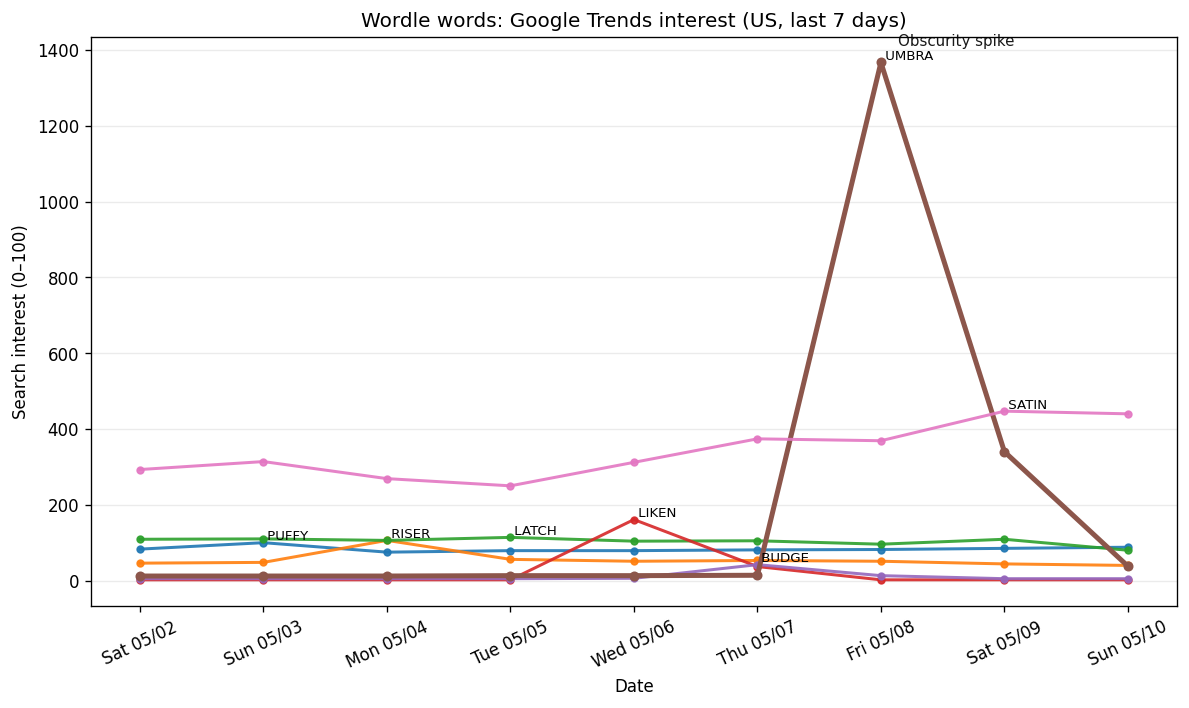
About this chart. Each line is one Wordle answer’s search interest in the United States over the past seven days (Google Trends “Interest over time”). Values are on Google’s 0–100 scale, so you can compare how often people searched each word relative to the others this week.
How the Spike % is calculated. For each word we take the quietest day in that window (the lowest point on its line) as its usual level for the week, and the busiest day (the highest point) as the peak. The spike is the percentage increase from that low to that high: (peak − low) ÷ max(low, 1) × 100. If the week’s low is zero, we divide by 1 instead of 0 so the spike still measures how much interest rose from the floor to the peak. A larger spike means searches jumped more sharply when that word was the daily answer.
In our analysis, we often distinguish between the "chart swing"—the raw numerical difference between the week's low and high—and the percentage spike. For instance, SATIN saw a respectable raw swing of 197 points, yet its percentage growth was a modest 79% because it maintains a high baseline of interest in everyday search. Conversely, UMBRA dominated both metrics; its massive 1355-point swing resulted in a staggering 11292% spike because it began from such a quiet, specialized baseline. This suggests that while many people use the word SATIN daily, UMBRA was a genuine discovery for the vast majority of players.
For those who enjoy a bit of word play beyond the grid, you might notice that SATIN belongs to a prolific anagram group including SAINT and STAIN—it’s a fun little word jumble hidden in plain sight.
This week’s words
| Date | Word | Spike | Meaning |
|---|---|---|---|
| Sun, May 3 | PUFFY | +33% | (adj. puffier, puffiest) Swollen or expanded, often with air or soft material. (adj. puffier, puffiest) Light and airy in texture or appearance. |
| Mon, May 4 | RISER | +165% | (n. pl. risers) One that rises. (n. pl. risers) The vertical part of a stair step. (n. pl. risers) A vertical pipe or duct. |
| Tue, May 5 | LATCH | +42% | (v.) To fasten or close with a latch. (n. pl. latches) A movable bar or rod that holds a door or gate shut. (v.) To attach oneself to or take hold of something. |
| Wed, May 6 | LIKEN | +7950% | (v.) to represent as similar; to compare. |
| Thu, May 7 | BUDGE | +740% | (v.) To move or shift slightly. (v.) To give way; to yield. |
| Fri, May 8 | UMBRA | +11292% | (n. pl. umbrae or umbras) The darkest part of a shadow, especially the central part of a shadow cast by a celestial body. (n. pl. umbrae or umbras) The dark central part of a sunspot. (n. pl. umbrae o |
| Sat, May 9 | SATIN | +79% | (n. pl. satins) A fabric, often silk or rayon, with a smooth, glossy surface on one side. (adj.) Made of satin; having a smooth, glossy surface. (v.) To make smooth and glossy. |
Obscurity winner
Using search interest in the US over the last seven days, I looked for the biggest “obscurity spikes”—words that saw the largest percentage jump in searches when they appeared as the answer in the daily puzzle. This week's standout was UMBRA, with search interest spiking by about 11292% from its usual baseline. Most days this week it hovered around 12 or so on the search scale, and then it jumped up to about 1367 when it hit the grid. For a mid-pack difficulty word, that spike is a real mountain on the charts.
The runner-up in this week's data was LIKEN, which saw a significant 7950% increase. While "liken" is a common enough verb, its baseline search frequency is incredibly low (around 2), meaning even a moderate number of curious players can send its percentage soaring.
Whether you aced every grid or learned a new word or two, I hope you had fun. Word games ought to feel like a treat, not a test. If you'd like to explore the trends yourself, you can see the full comparison below.
View these words on Google Trends (US, last 7 days)
The top 5 most obscure words used in Wordle, since I started doing this March 1, 2026, are still CAROM (+70000%), ELFIN (+35900%), CUBIT (+33500%), GUNKY (+27500%), BEFIT (+25800%).
Word game sentence
The early riser struggled to latch the window as puffy storm clouds began to gather, but the heavy satin drapes wouldn't budge, casting an umbra over the study that one might liken to a total eclipse.
This construction manages to weave the week's vocabulary into a surprisingly cohesive, if slightly dramatic, narrative. The transition from the tactile "satin" to the scientific "umbra" provides a nice contrast in registers, reflecting the varied difficulty we see in daily play. It's always a pleasure to see how these disparate words can find a home together in a single thought.
For Math Nerds
What this section is for. It documents exactly how each week’s spike numbers were computed from the scaled Google Trends series, so curious readers can verify the arithmetic.
Trends window. We request a custom date range 2026-05-02 2026-05-10 (US), which is the Wordle week plus one day before and after so the chart has a little context on each side. The anchor keyword for cross-request scaling is PUFFY (the first day’s answer, in chronological order).
Scaling across separate requests. Google Trends only returns relative 0–100 values within one request. We fetch each answer in its own request paired with that anchor, then rescale each day so the anchor’s curve matches the anchor series from the first request. Concretely: scaledword(d) = rawword(d) × base_anchor(d) / rawanchor(d) when rawanchor(d) > 0, else 0.
Spike % for one word. Let L be the minimum and H the maximum of that word’s scaled daily values over the window (see table below). Define spike% = (H − L) / max(L, 1) × 100 when L ≠ H, otherwise 0%. Using max(L, 1) avoids division by zero when L = 0.
PUFFY (Wordle day 2026-05-03)
Scaled interest by date; spike for rankings uses +33% from this series.
| Date | Interest |
|---|---|
| 2026-05-02 | 83 |
| 2026-05-03 | 100 |
| 2026-05-04 | 75 |
| 2026-05-05 | 79 |
| 2026-05-06 | 79 |
| 2026-05-07 | 81 |
| 2026-05-08 | 82 |
| 2026-05-09 | 85 |
| 2026-05-10 | 88 |
- L = 75 on: 2026-05-04
- H = 100 on: 2026-05-03
- Denominator
max(L, 1)= 75 - (100 - 75) / 75 * 100 = 33.3333%
RISER (Wordle day 2026-05-04)
Scaled interest by date; spike for rankings uses +165% from this series.
| Date | Interest |
|---|---|
| 2026-05-02 | 46 |
| 2026-05-03 | 48 |
| 2026-05-04 | 106 |
| 2026-05-05 | 56 |
| 2026-05-06 | 51 |
| 2026-05-07 | 53 |
| 2026-05-08 | 51 |
| 2026-05-09 | 44 |
| 2026-05-10 | 40 |
- L = 40 on: 2026-05-10
- H = 106 on: 2026-05-04
- Denominator
max(L, 1)= 40 - (106 - 40) / 40 * 100 = 165.0000%
LATCH (Wordle day 2026-05-05)
Scaled interest by date; spike for rankings uses +42% from this series.
| Date | Interest |
|---|---|
| 2026-05-02 | 109 |
| 2026-05-03 | 110 |
| 2026-05-04 | 106 |
| 2026-05-05 | 114 |
| 2026-05-06 | 104 |
| 2026-05-07 | 105 |
| 2026-05-08 | 96 |
| 2026-05-09 | 109 |
| 2026-05-10 | 80 |
- L = 80 on: 2026-05-10
- H = 114 on: 2026-05-05
- Denominator
max(L, 1)= 80 - (114 - 80) / 80 * 100 = 42.5000%
LIKEN (Wordle day 2026-05-06)
Scaled interest by date; spike for rankings uses +7950% from this series.
| Date | Interest |
|---|---|
| 2026-05-02 | 2 |
| 2026-05-03 | 2 |
| 2026-05-04 | 2 |
| 2026-05-05 | 2 |
| 2026-05-06 | 161 |
| 2026-05-07 | 37 |
| 2026-05-08 | 2 |
| 2026-05-09 | 2 |
| 2026-05-10 | 2 |
- L = 2 on: 2026-05-02, 2026-05-03, 2026-05-04, 2026-05-05, 2026-05-08, 2026-05-09, 2026-05-10
- H = 161 on: 2026-05-06
- Denominator
max(L, 1)= 2 - (161 - 2) / 2 * 100 = 7950.0000%
BUDGE (Wordle day 2026-05-07)
Scaled interest by date; spike for rankings uses +740% from this series.
| Date | Interest |
|---|---|
| 2026-05-02 | 5 |
| 2026-05-03 | 5 |
| 2026-05-04 | 5 |
| 2026-05-05 | 5 |
| 2026-05-06 | 6 |
| 2026-05-07 | 42 |
| 2026-05-08 | 13 |
| 2026-05-09 | 5 |
| 2026-05-10 | 5 |
- L = 5 on: 2026-05-02, 2026-05-03, 2026-05-04, 2026-05-05, 2026-05-09, 2026-05-10
- H = 42 on: 2026-05-07
- Denominator
max(L, 1)= 5 - (42 - 5) / 5 * 100 = 740.0000%
UMBRA (Wordle day 2026-05-08)
Scaled interest by date; spike for rankings uses +11292% from this series.
| Date | Interest |
|---|---|
| 2026-05-02 | 12 |
| 2026-05-03 | 12 |
| 2026-05-04 | 12 |
| 2026-05-05 | 13 |
| 2026-05-06 | 13 |
| 2026-05-07 | 14 |
| 2026-05-08 | 1367 |
| 2026-05-09 | 340 |
| 2026-05-10 | 38 |
- L = 12 on: 2026-05-02, 2026-05-03, 2026-05-04
- H = 1367 on: 2026-05-08
- Denominator
max(L, 1)= 12 - (1367 - 12) / 12 * 100 = 11291.6667%
SATIN (Wordle day 2026-05-09)
Scaled interest by date; spike for rankings uses +79% from this series.
| Date | Interest |
|---|---|
| 2026-05-02 | 293 |
| 2026-05-03 | 314 |
| 2026-05-04 | 269 |
| 2026-05-05 | 250 |
| 2026-05-06 | 312 |
| 2026-05-07 | 374 |
| 2026-05-08 | 369 |
| 2026-05-09 | 447 |
| 2026-05-10 | 440 |
- L = 250 on: 2026-05-05
- H = 447 on: 2026-05-09
- Denominator
max(L, 1)= 250 - (447 - 250) / 250 * 100 = 78.8000%
Ranking order sorts words by spike% descending; ties are broken only by Python’s stable sort (original dict iteration order), not by puzzle date.