
No one likes to feel like a sucker over morning coffee, but March 29, 2026 served up a delightfully blunt little jab when CHUMP landed as the day's Wordle solution.
Meaning
In modern parlance, a chump is almost always a gullible, foolish, or easily deceived person—the classic mark who buys the Brooklyn Bridge. Tucked beneath that familiar slang, however, lies an older, toothier verb form meaning to chew noisily or munch. The term likely emerged in the eighteenth century as a cousin to words like chunk and lump, originally describing a thick, senseless block of wood before our ancestors inevitably turned it on each other as an insult for a blockhead.
You might encounter it in classic noir dialogue: "He thought he was running the table, but he walked out looking like an absolute chump."
Open CHUMP in the Gramma Ana dictionary.
How we measured obscurity
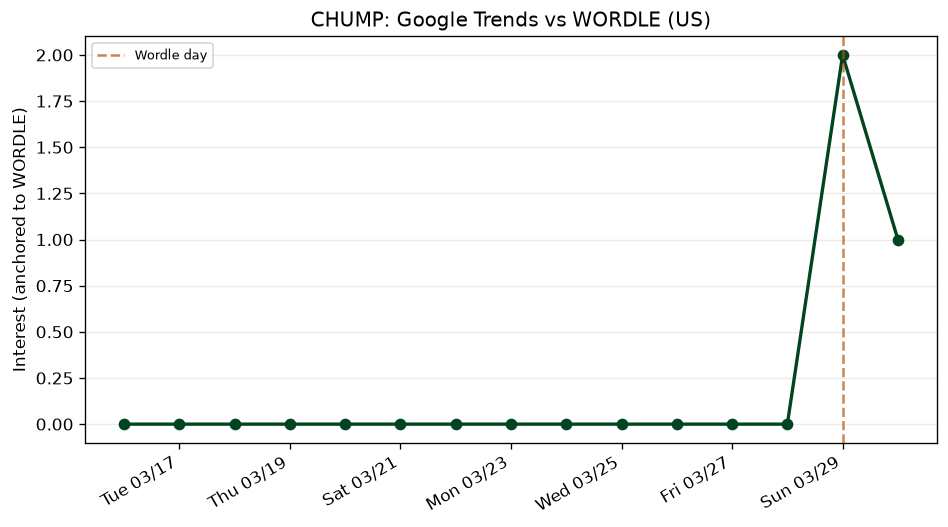
To evaluate how much a word catches solvers off guard, we evaluate curiosity spikes using search interest transported onto a shared chart anchored to "WORDLE." Anchoring each query to a fixed scale ensures that H remains directly comparable between words, rather than forcing every term's peak to an arbitrary 100 on an isolated graph. Leading up to the puzzle, CHUMP sat at a quiet baseline of L ≈ 0, rising to H ≈ 2 on game day. That yields a spike of about 200% via our formula, (H − L) / max(L, 1) × 100. While that sits well below our historical 90th-percentile benchmark (a threshold of roughly 3220% across our benchmark set, n ≈ 7), it still captures a tidy burst of players double-checking their hunches.
Whether you solved the grid in a breezy three guesses or found yourself feeling momentarily chumped by the consonants, remember that every puzzle teaches us a bit more about our quirky tongue. Have fun with your daily word games, and I will see you at tomorrow's grid!
Where it ranks
CHUMP is ranked number 11 on our list of 11 words that we have looked at since March 1, 2026. It is currently the least obscure word on our list.
- CAROM — Wordle Apr 10, 2026 (+6800%, H=68) — obscurity post
- SERIF — Wordle Mar 23, 2026 (+4000%, H=40) — obscurity post
- SHOAL — Wordle Mar 10, 2026 (+2700%, H=27) — obscurity post
- BEFIT — Wordle Mar 26, 2026 (+1500%, H=15) — obscurity post
- AMPLY — Wordle Mar 18, 2026 (+1100%, H=11) — obscurity post
- BROOD — Wordle Mar 24, 2026 (+700%, H=7) — obscurity post
- GUNKY — Wordle Mar 6, 2026 (+600%, H=6) — obscurity post
- SINGE — Wordle Apr 3, 2026 (+500%, H=5) — obscurity post
- AFOOT — Wordle Mar 28, 2026 (+400%, H=4) — obscurity post
- PRUDE — Wordle Apr 11, 2026 (+400%, H=4) — obscurity post
How we measure Wordle “obscurity” (plain English + careful math)
The everyday idea
When a hard Wordle answer drops, people google it. A more obscure answer tends to send more people to the search box, relative to how often that word is usually searched.
We’re trying to measure that “sudden rush of lookups,” then keep a leaderboard of the most obscure answers we’ve scored since March 1, 2026. This post is about CHUMP; right now the leader on that list is CAROM.
The catch with Google Trends
Google Trends does not tell us “12,000 people searched CHUMP today.”
It gives a relative score from 0 to 100 inside whatever search you asked for. Think of it like grading on a curve for that one chart only:
- The busiest thing in that chart gets 100
- Everything else is scaled down from that peak
So if you looked up CHUMP alone, Trends would often stretch CHUMP so its busiest day is 100 — even if, in real life, far fewer people searched it than searched a huge term like WORDLE. The same would happen for CAROM on its own private chart. Those two solo charts would not share a yardstick, so you couldn’t fairly ask which Wordle day really drew more lookups.
Our fix: put every word on the same yardstick
We always compare each Wordle answer to a fixed reference word: WORDLE.
- First we ask Trends for WORDLE alone. That becomes our shared ruler (the “WORDLE chart”).
- Then we ask Trends for WORDLE + the answer together (for this post: WORDLE + CHUMP; for the current leader: WORDLE + CAROM). In each joint chart, the two words are already drawn to the same scale.
- We then translate the answer’s line onto the shared WORDLE ruler, day by day.
In words:
“On this day, CHUMP was X% as busy as WORDLE in the joint chart; map that onto how busy WORDLE looks on our master WORDLE chart.”
After that translation, CHUMP’s height and CAROM’s height mean something comparable. If CAROM’s Wordle-day height is bigger than CHUMP’s, that really does look like more lookup activity relative to WORDLE, not just “both hit the top of their own private chart.”
We call that shared-scale score the Obscurity Index series.
The spike math (the only formula that matters)
For one answer word on its Wordle day:
- L = the quietest day before the Wordle day (on the shared WORDLE scale)
- H = interest on the Wordle day (same scale)
Then:
Spike % = (H − L) ÷ max(L, 1) × 100
Careful reading of that:
- If interest goes from 2 to 22, spike = (22−2)/2 × 100 = 1000% (“ten times the quiet baseline, as a percent increase”).
- If the quiet baseline is 0, we pretend the baseline is 1 so we don’t divide by zero. That’s why a jump from 0→11 becomes 1100%, not infinity — which is the kind of jump CHUMP can show on this scale.
So the percentage is “how big was the jump from the pre-Wordle lull to Wordle day?”
H itself is the “how tall was that Wordle-day spike on the WORDLE yardstick?” number we also show on the list.
A word can look obscure either because the jump is huge, or because H is large (lots of lookups vs WORDLE), or both. We rank by the spike %, and we display H so volume isn’t invisible. That’s how CAROM can sit above CHUMP on the list even though both were sticky Wordle days.
What has to be true before we write a blog post
We don’t post about every Wordle answer. We post when:
- Trends data exists
- Wordle-day interest isn’t zero
- The Wordle day really is the peak in the window we looked at (so we’re not celebrating a random other spike)
- The spike clears a high bar: about the 90th percentile of our earlier scores on this same WORDLE-anchored scale (roughly: “as obscure as the obscurest 10% we’ve already measured”)
The “Where it ranks” section
That section above is built live when you open the page:
- only words scored on this WORDLE-anchored method
- sorted most obscure first
- one short sentence about CHUMP’s place
- then the shared list (CAROM at the top right now, with CHUMP highlighted here)
When a new obscure answer lands and reshuffles the order, this page updates with it. No frozen snapshot of an old ranking.
One-sentence summary
We map every Wordle answer onto a shared WORDLE scale, measure the jump from “quiet before Wordle” to “Wordle day,” and only blog the ones that clear a top-tier obscurity bar — with a live leaderboard so CHUMP’s place next to CAROM (and whoever comes next) stays honest.