Few five-letter words land with quite as satisfying a guttural thud as DRECK, which left more than a few morning coffee drinkers furrowing their brows when it landed as the Wordle answer on November 6, 2026.
Meaning
At its core, dreck refers to trash, junk, or utter rubbish—anything cheap, worthless, or of shockingly poor quality. English borrowed the term from Yiddish (drek), where it traces back to Germanic roots meaning dirt, filth, or dung.
You will often hear it wielded by weary arts reviewers: "Despite a starry cast and a hundred-million-dollar budget, the studio's latest sci-fi release was unwatchable dreck."
Open DRECK in the Gramma Ana dictionary.
How we measured obscurity
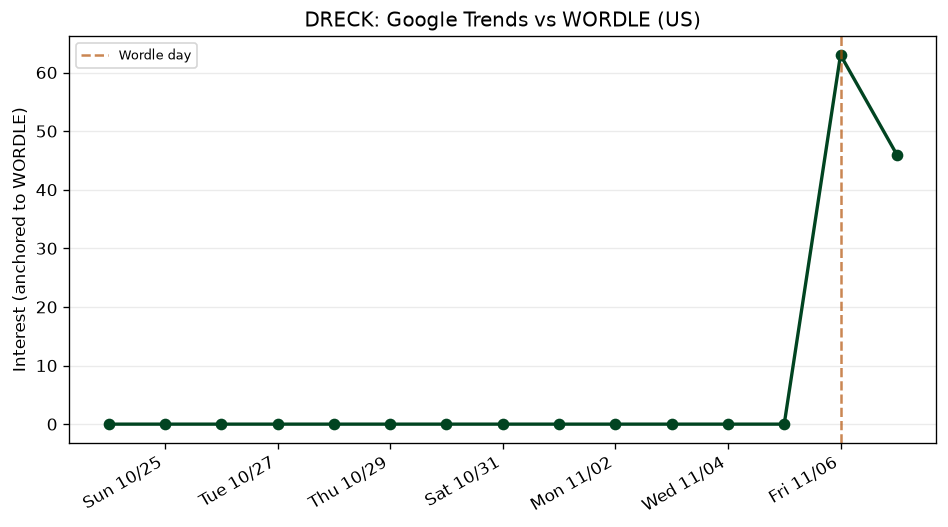
To quantify how unusual the word felt to the playing public, we look at our Wordle-anchored Obscurity Index. Instead of relying on isolated search queries—where every tiny word's peak is deceptively pegged at 100—we transport search interest onto a shared scale anchored directly to the puzzle itself. Before the puzzle appeared, baseline interest (L) was practically invisible at roughly 0. On game day, lookup activity (H) surged to approximately 63 on that same universal scale. That represents a dramatic spike of about 6300%, easily sailing past our obscurity gate (the 70th percentile of cleaned past hits, which sits near 1250% across 76 evaluated words) and earning a difficulty mark of 76.
Whether this one treated you kindly or cost you your streak, remember that even a thorny board adds a marvelous new term to your vocabulary shelf. Best of luck on tomorrow's grid!
Where it ranks
DRECK is ranked number 3 on our list of 80 words that we have looked at since March 1, 2026. It falls right between PRATE and ETUDE.
- CAROM — Wordle Apr 10, 2026 (+6800%, H=68) — obscurity post
- PRATE — Wordle Nov 7, 2026 (+6600%, H=66) — obscurity post
- DRECK — Wordle Nov 6, 2026 (+6300%, H=63) (this post) — obscurity post
- ETUDE — Wordle May 31, 2026 (+5000%, H=50) — obscurity post
- COPSE — Wordle Sep 25, 2026 (+4100%, H=41) — obscurity post
- SERIF — Wordle Mar 23, 2026 (+4000%, H=40) — obscurity post
- OVATE — Wordle Jun 22, 2026 (+3800%, H=38) — obscurity post
- UMBRA — Wordle May 8, 2026 (+3800%, H=38) — obscurity post
- GRIST — Wordle Oct 28, 2026 (+3700%, H=37) — obscurity post
- USURY — Wordle Oct 2, 2026 (+3700%, H=37) — obscurity post
How we measure Wordle “obscurity” (plain English + careful math)
The everyday idea
When a hard Wordle answer drops, people google it. A more obscure answer tends to send more people to the search box, relative to how often that word is usually searched.
We’re trying to measure that “sudden rush of lookups,” then keep a leaderboard of the most obscure answers we’ve scored since March 1, 2026. This post is about DRECK; right now the leader on that list is CAROM.
The catch with Google Trends
Google Trends does not tell us “12,000 people searched DRECK today.”
It gives a relative score from 0 to 100 inside whatever search you asked for. Think of it like grading on a curve for that one chart only:
- The busiest thing in that chart gets 100
- Everything else is scaled down from that peak
So if you looked up DRECK alone, Trends would often stretch DRECK so its busiest day is 100 — even if, in real life, far fewer people searched it than searched a huge term like WORDLE. The same would happen for CAROM on its own private chart. Those two solo charts would not share a yardstick, so you couldn’t fairly ask which Wordle day really drew more lookups.
Our fix: put every word on the same yardstick
We always compare each Wordle answer to a fixed reference word: WORDLE.
- First we ask Trends for WORDLE alone. That becomes our shared ruler (the “WORDLE chart”).
- Then we ask Trends for WORDLE + the answer together (for this post: WORDLE + DRECK; for the current leader: WORDLE + CAROM). In each joint chart, the two words are already drawn to the same scale.
- We then translate the answer’s line onto the shared WORDLE ruler, day by day.
In words:
“On this day, DRECK was X% as busy as WORDLE in the joint chart; map that onto how busy WORDLE looks on our master WORDLE chart.”
After that translation, DRECK’s height and CAROM’s height mean something comparable. If CAROM’s Wordle-day height is bigger than DRECK’s, that really does look like more lookup activity relative to WORDLE, not just “both hit the top of their own private chart.”
We call that shared-scale score the Obscurity Index series.
The spike math (the only formula that matters)
For one answer word on its Wordle day:
- L = the quietest day before the Wordle day (on the shared WORDLE scale)
- H = interest on the Wordle day (same scale)
Then:
Spike % = (H − L) ÷ max(L, 1) × 100
Careful reading of that:
- If interest goes from 2 to 22, spike = (22−2)/2 × 100 = 1000% (“ten times the quiet baseline, as a percent increase”).
- If the quiet baseline is 0, we pretend the baseline is 1 so we don’t divide by zero. That’s why a jump from 0→11 becomes 1100%, not infinity — which is the kind of jump DRECK can show on this scale.
So the percentage is “how big was the jump from the pre-Wordle lull to Wordle day?”
H itself is the “how tall was that Wordle-day spike on the WORDLE yardstick?” number we also show on the list.
A word can look obscure either because the jump is huge, or because H is large (lots of lookups vs WORDLE), or both. We rank by the spike %, and we display H so volume isn’t invisible. That’s how CAROM can sit above DRECK on the list even though both were sticky Wordle days.
One-sentence summary
We map every Wordle answer onto a shared WORDLE scale, measure the jump from “quiet before Wordle” to “Wordle day,” and only blog the ones that clear a top-tier obscurity bar — with a live leaderboard so DRECK’s place next to CAROM (and whoever comes next) stays honest.